The Hollow Victory
I was in college with very simple ambitions, just like most guys my age. The ultimate goal was to secure a job so I’d never have to ask my Papa for money again. The simple goals were a girlfriend, good marks, and—of course—Cricket.
I was so passionate about the game that I spent hours glued to the radio commentary. A TV was a luxury we couldn’t afford, but in my young mind, I wanted to see matches on the biggest screen possible. My only access to that dream was the big electronics shops that played live matches in their windows.
For hours, I stood on the roadside for hours just to watch. There were many like me—a crowd of 50 or 60 people gathered around a glass window, cheering in unison and abusing profusely whenever India lost a wicket. We created such a ruckus that the shopkeeper would often turn the TV off just to disperse the crowd. I used to think he was a sadist. Standing there, on the hot pavement, I made a promise to myself: If I ever earn enough to afford a big screen, I will buy it and enjoy the match from the comfort of my own home.
The Dream vs. The Reality
That day came nearly five years later.
I blew five times my monthly income to buy the big screen of my dreams. It felt like healing a wound hidden deep in my heart. It felt like I had finally “arrived.”
But there was a problem.
I was no longer that passionate. The charm of the TV was quickly replaced by the anxiety of the EMIs. The match looked the same—the pixels were perfect, the sound was surround—but it felt far less enjoyable. The thrill was gone, replaced by a subtle, heavy burden.
Then the process repeated itself. Macs, iPhones, iPads, cars, a house—the list continued. Lakhs of rupees went into the hands of advertisers who pushed their products as magic pills of happiness. And I, just in the quest for solace—even a quantum of it—was convinced. Or rather, fooled.
The Realization
I became a hollow person with a lot of gadgets. The more I bought, the more I realized that the “hunger” inside wasn’t for things. It was for something else entirely. No object brought satisfaction. The finish line kept moving.
And that is why I can now profoundly understand what Maitreyi meant when she asked her husband, the great Sage Yajnavalkya:
“If I had all the wealth in the world, would I become immortal?”
Yajnavalkya was honest. He didn’t sugarcoat it.
“No. You would live a very comfortable life. But there is no hope of immortality through money.”
Maitreyi pushed the gold away.
“Then what use is this to me? Teach me what you know.”
Most of us spend our lives in the “comfortable life” trap, terrified to ask the question Maitreyi asked. But to get the answer, we have to look at the man she was talking to.
Maharishi Yajnavalkya.
If you think he was just another boring, chant-repeating priest, you are mistaken. He was the ancient world’s first true Outlaw. He was a man who grew so sick of “social conditioning” that he vomited it out.
The Myth of the Vomit: An Intellectual Divorce
To understand Yajnavalkya, you have to understand the environment he grew up in.
It was the late Vedic period. Religion had become bureaucratic. The Vedas were being taught by rote memorization. It was an era of “copy-paste” wisdom. You didn’t question the Guru; you just downloaded the file and stored it in your brain.
Yajnavalkya was the star student of Sage Vaishampayana, the keeper of the Yajur Veda. By all metrics, Yajnavalkya had it made. He was the head boy, the heir apparent. He had the “Corporate tenure” of the spiritual world.
The Flaw in the System
But Yajnavalkya had a sharp, critical mind. He noticed that the teachings were messy. The Mantras (the poetic verses) were mixed up with the Brahmanas (the ritual instructions). It was like reading a beautiful novel where someone had pasted a user manual for a microwave in the middle of every chapter. It was chaotic. It was “impure.”
The breaking point came when Vaishampayana committed a minor sin—accidental manslaughter of a Brahmin. The Guru, bound by tradition, asked his disciples to perform a penance on his behalf.
The other disciples nodded like sheep. “Yes, Master. We will do it.”
Yajnavalkya stood up. He looked at his classmates with disdain. He looked at his Guru and said, “Why bother with these feeble men? Their energy is low. I alone will perform the penance for you.”
It sounded arrogant. It was arrogant. But it was also true. He knew his own competence.
Vaishampayana, however, was furious. His ego was bruised. He shouted, “You are proud! You insult your brothers! I do not want a disciple like you. Go away! And before you go, give me back everything I have taught you.”
This is the moment that defines the man.
Most of us, faced with losing our job, our status, or our inheritance, would apologize. We would grovel. We would say, “I’m sorry, I’ll fall in line.”
Yajnavalkya did not apologize.
Using a mystic technique of Yoga, he performed, and literally vomited the knowledge out of his body. The myth says the other disciples turned into Tittiri birds (partridges) and eagerly pecked up the vomit.
This is a grotesque image, but the symbolism is powerful. The “Old School” was feeding on regurgitated, second-hand knowledge. They were eating what someone else had rejected. This became the Krishna (Black) Yajurveda—”Black” not because it is evil, but because it is mixed, obscured, and unorganized.
Yajnavalkya walked away. Empty. Alone. But free.
Chasing the Sun: The Quest for “Ayatayama”
Now imagine his state. He is a scholar with no knowledge. He has deleted his hard drive. He is the “Hollow Man” I described earlier, but unlike me with my gadgets, he made himself hollow on purpose.
He refused to find another human teacher. He realized that human teachers just pass on their own biases and limitations. He wanted the Source.
He walked into the wilderness and looked up at Surya (The Sun).
Why the Sun? Because the Sun is the only thing in the visible universe that is self-luminous. It doesn’t borrow light from anyone else. It gives without asking. And most importantly, the Sun is always new. Every sunrise is a unique event.
Yajnavalkya stood on one leg, staring at the blazing orb, and made a demand that echoes through history:
“O Lord of Light, teach me. But do not teach me what is already known. Teach me that which is Ayatayama.”
Ayatayama translates to “Not Stale.” It means knowledge that is fresh, raw, and original.
He didn’t want the “Best Practices.” He didn’t want the “Industry Standard.” He wanted the Truth as it is, before human beings mess it up.
The Sun, pleased by this fierce independence, took the form of a horse (Vajin)—symbolizing speed and power—and revealed to him a new Veda.
This became the Shukla (White) Yajurveda. “White” because it was clear. The verses were separated from the commentary. The code was cleaned up. It was the first “Clean Code” in human history.
The Cows of King Janaka: The Pragmatic Sage
If the story stopped here, Yajnavalkya would just be a mystic in the forest. But he wasn’t. He came back to civilization. And he came back to dominate.
This brings us to the famous assembly of King Janaka.
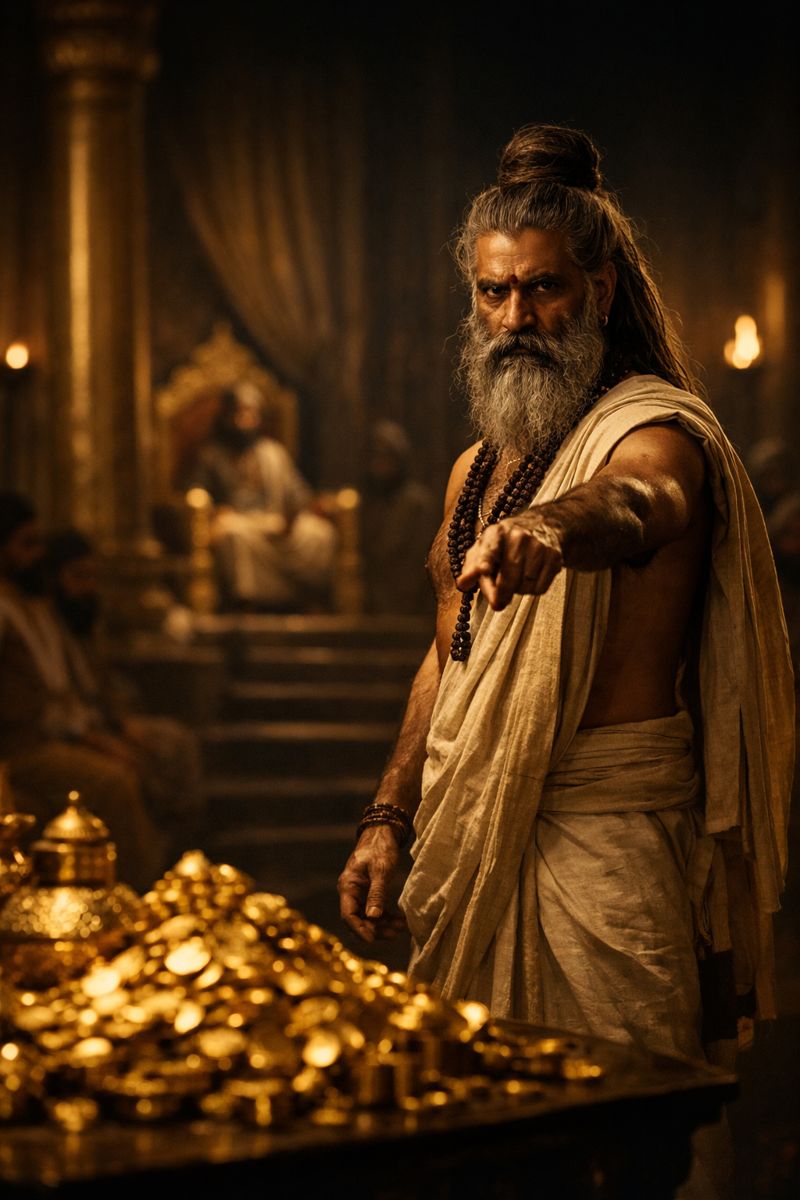
Janaka, the King of Videha (Mithila), was a philosopher-king. He wanted to find the greatest mind in India. He gathered thousands of Brahmins and penned 1,000 cows. To the horns of each cow, he tied 10 gold coins (some texts say 10 padas of gold).
He announced: “Let the one who is the ‘Brahmiṣṭha’ (the most knower of Brahman) among you drive these cows home.”
Silence fell over the assembly.
The stakes were too high. To claim the cows was to claim you were better than everyone else. If you took them and lost a debate, you would be humiliated. The “humble” sages sat quietly. The insecure sages sat quietly.
Yajnavalkya was sitting in the back. He didn’t look at the other priests. He looked at the cows. He looked at the gold.
He turned to his young disciple, Samashravas, and said in a loud, clear voice: “Son, drive these cows to my house.”
The room exploded. The royal priests, the old scholars, the king’s advisors—they all jumped up. “Yajnavalkya! Do you believe you are the wisest among us? How dare you take the prize before the contest?!”
Yajnavalkya smiled. It was the smile of a man who has seen the Sun and is no longer impressed by candles. “I bow to the wisest one,” he said with a smirk. “But I really wanted the cows.”
He was challenged by eight different masters.
-
Ashvala the ritualist attacked him on technicalities. Yajnavalkya dismantled him.
-
Uddalaka Aruni (a giant of philosophy) attacked him on metaphysics. Yajnavalkya silenced him.
-
Gargi Vachaknavi, the great female scholar, attacked him on the nature of reality. He pushed her to the edge of logic until she had to sit down.
He defeated them all. He kept the cows. He kept the gold.
This is why Yajnavalkya is the patron saint of the “Outlaw.” He proved that you don’t have to be poor to be spiritual. You don’t have to be meek to be wise. You can have the wealth of a King and the wisdom of a Sage—if you know the Self.
Advanced Learners Class: Decoding the Symbols
This section is for those who want to look under the hood of the mythology. What does this actually mean for your own psychology?
1. The Psychology of “The Vomit” (Conditioning vs. Consciousness)
The conflict between the Black Yajurveda (Old School) and White Yajurveda (New School) is not just history; it is a map of the human mind.
-
Krishna (Black) State: This is how 99% of us live. Our “actions” (rituals) and our “understanding” (mantras) are mixed together. We go to work, buy the TV, pay the EMI, and get married, but we don’t know why. The meaning is lost in the mechanics. We are operating on autopilot, repeating the “Black” mixed-up patterns of our parents and society.
-
Shukla (White) State: This is the state of Clarity. Yajnavalkya separated the Mantra (The Theory/Spirit) from the Brahmana (The Practice). In your life, this means separating who you are from what you do. It means acting with total awareness. You can still buy the TV, but you are no longer possessed by it.
2. The Sun as the Metaphor for the Self
Why did he go to the Sun? In the Upanishads, the Sun often represents the Atman (The Self). The moon has phases; it waxes and wanes (like our mind/moods). The fire dies out if you don’t feed it wood (like our body needs food). But the Sun? The Sun is Svarat—self-ruling. Yajnavalkya rejecting the human Guru to learn from the Sun symbolizes a shift from Instruction (learning from outside) to Intuition (learning from the light inside). He stopped reading books and started reading his own consciousness.
3. The “Cows” are not just Cattle
In Vedic symbolism, “Go” (Cow) also translates to “Sense Organs” or “Rays of Light.” When Yajnavalkya drives the 1,000 cows to his home, it is a code. He is saying: “I am the Master of my senses.” The other sages were slaves to their senses—they were afraid, jealous, and insecure. Yajnavalkya had mastered his senses so thoroughly that he could “drive them” wherever he pleased. The gold on the horns represents the brilliance of the intellect that adorns a controlled mind.
Conclusion: The Threshold of the Forest
Yajnavalkya had it all. He had the “fresh” knowledge from the Sun. He had the immense wealth from the King. He had the fame of being the unconquered debater. He had two wives, Maitreyi and Katyayani, and a loving family.
By the standards of my younger self—the boy standing outside the TV shop—Yajnavalkya had won the game. He had the biggest “screen,” the best “subscription,” and the highest “credit score.”
But here lies the twist that hits me in the gut every time I read it.
One day, at the height of his power, Yajnavalkya looked around his palace. He looked at the gold cows. He looked at his fame. And he felt exactly what I felt when I stared at my expensive TV.
It wasn’t enough.
He realized that everything he had accumulated was “external.” And anything external can be lost. He didn’t want the comfort of the cows anymore; he wanted the safety of the Eternal.
So, he stood up, walked to his wife Maitreyi, and said, “My dear, I am about to wander forth from this place. I am leaving everything behind.”
He was about to give up the very world he had conquered.
And it is in that moment of leaving that he gave Maitreyi the secret—the answer to why my TV, my car, and my gadgets never filled the hole in my heart. He taught her the doctrine of the Self.
But to understand that, we need to sit with him and Maitreyi in the next post.
“This was the Man. But what was his Secret? Stay tuned for Part 2, where we decode the conversation that changed Indian Philosophy forever: The Maitreyi Dialogue.”
Just Think Over It.
Maharishis dedicated their lives to unravel the deepest secrets of existence. Spare some time while you still can to understand their work.