The Mind Hacker’s Manual: A Complete Guide to Patanjali’s Code for Life
A guide to Patanjali Yoga Sutras Mind Hacking for the modern gamer.
Long before the advent of PlayStations and Xboxes, there was a video game console I was crazy about. It had a keyboard, two controllers, a gaming cassette containing games like Mario and shooting games, and a gun to shoot the birds in the shooting game. You needed to plug it into the TV, and a whole world of entertainment was sitting in front of you.
I distinctly remember playing these games for hours, even when my mum cursed me for not brushing my teeth every Sunday. I started feeling excitement on Fridays about the prospects of playing the game on Sunday. I dreamt about crossing a particular stage of Mario in my sleep. How that console controlled my life so much is still a question worth asking.
When Mario jumped on the screen, I jumped on my sofa. My sister, who liked to watch as I played, jumped too. When I fell down or died, it felt like a real loss—especially when a level on which I was stuck for days was about to get over. I felt my eyes moisten when Mario missed a jump. The character was virtual, but the reaction was as real as it gets. The loss felt tragic to my young mind.
After 30 years, I started to realize that most of my reactions to situations were like my reaction to the “Game Over” message. The mind created the win and the loss. Every pain and pleasure were mere states of mind. It reacted the way it wanted to. Instead of me being the Player, separate from the game, I became a character in the game itself. A source of enjoyment became a source of anxiety and pain.
And then I crossed paths with the words of the great Maharishi Patanjali.
The Mind Hacker’s Manual: Patanjali Yoga Sutras Mind Hacking
Imagine for a moment that you have just bought the most advanced, high-performance gaming rig in the universe. This biological machine—your body and brain—is capable of rendering 8K visuals, processing complex emotions, inventing rocket ships, and feeling intense love. It is a masterpiece of engineering.
But there is a massive problem: it didn’t come with a manual.
So, what do you do? You just start mashing buttons. You eat when you aren’t hungry. You scroll social media until your processor overheats. You worry about the future until your RAM crashes. You spend your whole life thinking the “game” is broken, when in reality, you just don’t know the controls.
Enter the Lead Developer: Maharishi Patanjali.
About 2,000 years ago, this genius “Mind Hacker” looked at the human condition and realized we were all playing the game wrong. He saw that we were suffering from lag, glitches, and system crashes. So, he wrote the source code to fix it. He called it the Yoga Sutras.
This is not a religious text. It is a technical manual. It is the documentation for your Operating System. Below is the full, comprehensive guide to hacking your mind, debugging your life, and playing the game in “God Mode,” explained in simple, glitch-free language.
Part 1: The Core Architecture (Hardware vs. Software)
To understand Patanjali, you have to understand the basic setup of the console. The biggest “bug” in human history—the reason for all our anxiety and depression—is a case of mistaken identity.
The Two Components: Player vs. Avatar
Patanjali divides reality into two distinct parts. If you mix these up, you lose.
The Avatar (Prakriti): This is the character on the screen. It includes your physical body, your job title, your bank account, your personality, and even your thoughts.
Features: It is constantly changing. It gets upgraded, it takes damage, it gets old, and eventually, it gets deleted (death).
The Nature: It runs on “Auto-Pilot” based on the code of nature.
The Player (Purusha): This is the User. The Consciousness. The Soul.
Features: It is sitting safely on the couch. It is holding the controller. It never changes. It cannot be cut, burned, or deleted. It just watches and experiences.
The Reality Check: You are the Player (Purusha) holding the controller, safe on the couch. You are not the Avatar (Prakriti) taking damage on the screen.

The Glitch: “Identity Confusion” (Avidya)
The root of all your suffering is a virus Patanjali calls Avidya (Ignorance). Here is how the glitch happens: you have been playing the game so intently for so long that you forgot you are on the couch.
When your Avatar gets rejected by a crush, you cry. When your Avatar loses money, you feel worthless. When the Avatar gets sick, you are terrified. You have identified completely with the character on the screen.
The Fix: Yoga is not about fixing the Avatar (though that happens). Yoga is the process of putting down the controller for a second, looking away from the screen, and saying:
“Oh, right. I am the Player. I am safe. The game is just a game.”
Part 2: The Operating System (The Mind)
Your mind (Chitta) is the screen where the game is displayed. Patanjali explains that your screen is currently unusable because of “Notification Spam.”
The Lag: Chitta Vritti (Fluctuations)
Patanjali defines Yoga in his second line of code (Sutra 1.2):
Yogas Chitta Vritti Nirodhah
“Yoga is the silencing of the notifications in the mind.”
Vritti (The Pop-ups): These are your thoughts. “Did I lock the door?” “Why did she look at me like that?” “I need to buy milk.” “I’m a failure.”
Every time a Vritti pops up, it ripples across your screen. Because your screen is constantly rippling with thousands of notifications per minute, you can’t see the game clearly. You are playing with 900ms lag.
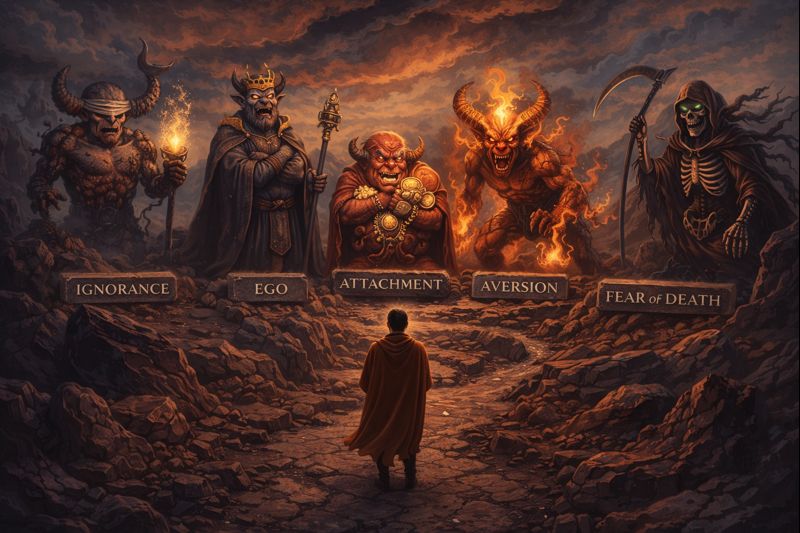
The Viruses: The 5 Kleshas (Afflictions)
Patanjali identifies five specific malware programs that destroy your gameplay experience.
-
Ignorance (Avidya): Mistaking the map for the territory. Thinking money = happiness.
-
Ego (Asmita): The “Main Character Syndrome.” Thinking the whole server revolves around you.
-
Attachment (Raga): Addiction. Wanting a temporary buff (like sugar, praise, or a high) to last forever.
-
Aversion (Dvesha): Rage-quitting. Hating the hard levels (traffic, difficult bosses, boredom) and trying to avoid them.
-
Fear of Deletion (Abhinivesha): The terror of “Game Over.” This is the deep-rooted fear of death that haunts even the wisest players.
Part 3: The Installation Guide (The 8 Limbs of Yoga)
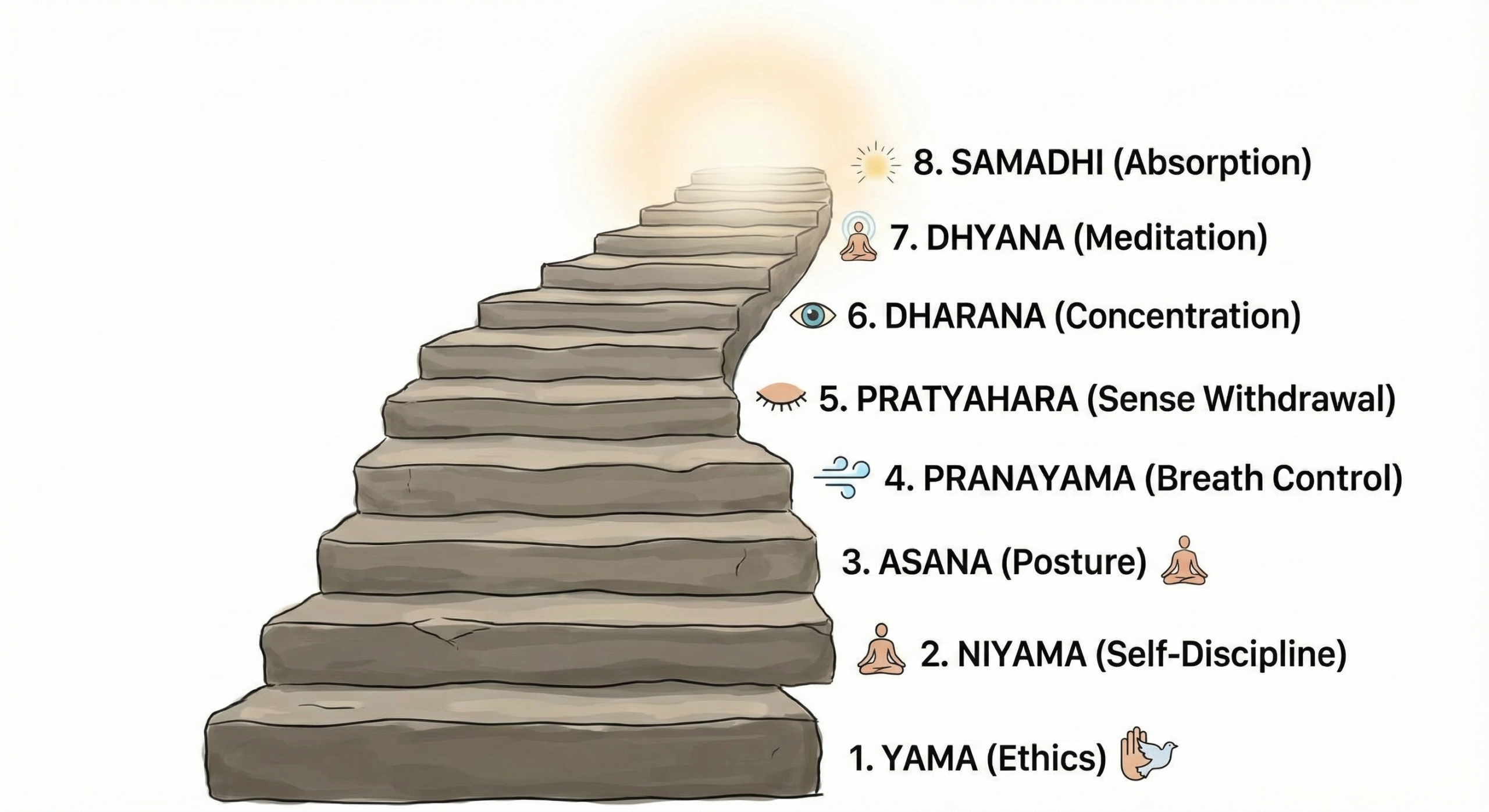
So, how do we apply Patanjali Yoga Sutras Mind Hacking to clean the malware? Patanjali gives us an eight-step installation wizard called Ashtanga Yoga. Most people think Yoga is just Step 3 (stretching). That’s like thinking a computer is just the keyboard. Here is the full stack.
Step 1: The Terms of Service (Yama)
Before you can log into the server of higher consciousness, you have to agree to the community guidelines. If you break these, the system will ban you (create bad karma).
Ahimsa (No Griefing): Do not harm others. In gaming terms, don’t be a toxic player. If you are toxic to others, your own stress levels rise, and your game lags. This includes not being toxic to yourself (negative self-talk).
Satya (No Cheat Codes): Tell the truth. Lying requires massive RAM to maintain the fabrication. Truth frees up your processor for better things.
Asteya (No Loot Stealing): Do not take what isn’t yours. This includes stealing time and credit.
Brahmacharya (Battery Saver Mode): Do not waste your energy. This is often interpreted as celibacy, but in a modern context, it means managing your “mana bar.” Don’t leak energy on doom-scrolling, petty arguments, or lust. Save it for the boss fights.
Aparigraha (Inventory Management): Don’t hoard. You don’t need 500 items in your inventory. Traveling light makes the character faster.
Step 2: System Maintenance (Niyama)
These are the daily protocols you must run to keep your hardware clean.
Saucha (Disk Cleanup): Keep the body clean and the environment organized. A messy room = a messy mind.
Santosha (User Satisfaction): Contentment. This is being happy with your current loot drop. If you are always angry that you didn’t get the legendary sword, you will miss the fun of the current level.
Tapas (Overclocking): Discipline. This is the heat generated when you force the system to work hard—getting up early, exercising, facing fears. It burns off the junk files.
Svadhyaya (Read the Logs): Self-study. Read the manual (wisdom texts) and analyze your own gameplay (journaling). “Why did I get angry today?”
Ishvara Pranidhana (Trust the Developer): Surrender. You didn’t code the game. You can’t control the weather or the other players. Do your best, and trust the server admin (the Universe) to handle the rest.
Step 3: Hardware Ergonomics (Asana)
Finally, the “Yoga Poses.” Patanjali doesn’t care if you can do a handstand. He says: Sthira Sukham Asanam (“Posture must be steady and comfortable”).
The logic: if your gaming chair has a nail sticking out of it, you can’t focus on the game. You will be fidgeting. Asana is simply hacking the body so it becomes a stable, pain-free vehicle that doesn’t distract the Player.
Step 4: The Cooling System (Pranayama)
Your CPU (brain) and your power supply (breath) are connected.
When the CPU overheats (anxiety), the fan spins fast (short, shallow breathing).
The hack: you can manually slow down the fan to cool the CPU. By taking long, slow breaths, you force the operating system to switch from “Survival Mode” to “Creative Mode.”
Step 5: Input/Output Control (Pratyahara)
This is “sense withdrawal.”
Your eyes, ears, and nose are constantly downloading data. It’s like having 50 Chrome tabs open.
Pratyahara is the “Disconnect” button. It’s putting on noise-canceling headphones. You stop downloading the outside world so you can process the inside world.
Step 6: The Laser Mouse (Dharana)
Concentration.
Most people play with a “spray and pray” aim—looking everywhere at once.
Dharana is the sniper scope. It is the ability to hold your cursor on one pixel (one thought, one breath, one mantra) for 12 seconds without flinching.
Step 7: The Flow State (Dhyana)
Meditation.
When you hold the sniper scope steady for a long time, the effort disappears. You enter “the zone.” You are no longer trying to focus; you are just flowing with the game. Time distorts. You look at the clock, and 20 minutes have passed in a second.
Step 8: God Mode (Samadhi)
The ultimate level.
The gap between the Player and the Avatar vanishes. There is no “I am playing the game.” There is only “Playing.”
The lag hits zero. You realize that you, the screen, and the game are all made of the same digital energy. This is enlightenment.
Part 4: The Walkthrough – Playing the Levels of Life
Now that we have the manual, how do we apply it to the specific levels of life? The game gets harder as you go, so your strategy must change.
Level 1: The Student (The Tutorial & Grinding Phase)
The Objective: Accumulate knowledge (XP) and skills.
The Main Enemy: Distraction and peer pressure (multiplayer toxicity).
In this phase, your hardware is fresh, but your software is glitchy. You are easily hacked by hormones and social validation.
Hack #1: The Single-Tab Browser (Dharana). A student’s brain is often trying to run TikTok, math, and texting simultaneously. This crashes the RAM. Patanjali’s advice is simple: one tab rule. When you study, the phone must be in another room (Pratyahara). Train your brain to lock onto one subject. A laser burns through obstacles; a flashlight just illuminates them. Be a laser.
Hack #2: Managing the Mana Bar (Brahmacharya). Teenagers have infinite energy but zero containment. They leak it on drama, obsession, and anxiety. Patanjali says: seal the leaks. Use that explosive energy to build your stats (grades, sports, art). Don’t waste your “ultimate ability” on a five-second dopamine hit.
Hack #3: Debugging Failure (Tapas). You will fail exams. You will get rejected. The default reaction is to quit. Patanjali says: apply tapas (heat). Use the failure as fuel. The friction of the struggle is what polishes the diamond. If the game was easy, it would be boring.
Level 2: The Worker & Householder (The Main Campaign)
The Objective: Build a base, manage resources, sustain the clan.
The Main Enemy: Stress, ego, and toxic NPCs.
Welcome to “Hard Mode.” Now you have a mortgage, a boss, and a spouse. The pressure is on.
Hack #1: The Karma Yoga Protocol (Kriya Yoga). You have to work. But how do you work without burning out? Patanjali gives the formula:
Do the work: write the code, make the sale, cook the dinner.
Delete the expectation.
You want the promotion. You want the praise. Patanjali says: “The right to the action is yours, but the loot drop is determined by the server.” If you obsess over the result, you will be anxious. If you focus on the craft, you will be a master.
Hack #2: The Mute Button for Toxic People (Upeksha). You will encounter trolls—angry bosses, jealous colleagues, irrational relatives.
Default reaction: argue back. (This feeds the troll and drains your battery.)
Patanjali’s reaction: upeksha (indifference). You realize that their anger is their graphics glitch, not yours. You don’t engage. You view them with a neutral “Hmm, interesting bug,” and walk away. This is the ultimate power move.
Hack #3: Inventory Control (Aparigraha). In your 30s and 40s, you want to buy stuff—better car, bigger house. Patanjali warns: the more items in your inventory, the slower you run. Own things, but don’t let things own you. If losing your watch ruins your week, you didn’t own the watch; the watch owned you. Practice being happy with the default skin occasionally.
Hack #4: Relationship Debugging (The “Sky vs. Weather” Patch). Your spouse is cranky? That is just the weather (Prakriti). The person you love is the sky (Purusha). The weather is temporary; the sky is permanent. Don’t divorce the sky just because it’s raining today. Wait for the storm to pass.
Level 3: The Retiree (Free Roam / Sandbox Mode)
The Objective: Wisdom, mentorship, inner exploration.
The Main Enemy: Boredom and identity crisis (class change).
The main quest is over. You retired. The kids moved out. The phone stopped ringing. Many players crash here because they don’t know what to do without a mission marker.
Hack #1: Switching to Observer Mode. For 40 years, you were a doer. You influenced the game world. Now, you must become a seer.
Stop trying to control your adult children. They are playing their own campaign now. If you try to play their game for them, you are just a backseat gamer. It’s annoying.
Sit back. Watch the graphics. Enjoy the beauty of the world without needing to conquer it.
Hack #2: Contentment Is the New High Score (Santosha). In Level 2, “more” was the goal. In Level 3, “enough” is the goal. Can you sit in your garden with a cup of tea and feel like a king? That is santosha. If you need a cruise ship to be happy, you are still grinding. If you are happy with the tea, you have won the game.
Hack #3: Reviewing the Logs (Svadhyaya). Use this time to read the developer notes (scriptures, philosophy). Understand the code of the universe. This is the time to optimize your internal software before the final shutdown.
Level 4: The End Game (The Log Off)
The Objective: Transitioning out of the Avatar.
The Main Enemy: Fear of death (Abhinivesha).
The hardware is failing. The frame rate is dropping. The screen is dimming. The “Game Over” screen is approaching.
Hack #1: The Cloud Save Strategy. The scariest part of death is thinking, “I will cease to exist.” Patanjali reminds you: you are not the hardware. You are the signal. The console (body) is breaking down, but the signal (consciousness) is simply uploading to the cloud. Energy cannot be destroyed.
Hack #2: The Final Surrender (Ishvara Pranidhana). You cannot fight the shutdown. The more you mash buttons trying to stay alive, the more you suffer. The master player knows when to put the controller down. You breathe out, relax your grip, and say, “Good game.” You log off with dignity, knowing that the Player was never in danger. The screen goes black, but the light of the viewer remains.
Conclusion: How to Start Playing Today
You don’t need to go to a cave in the Himalayas to use this manual. You can start the patch update right now.
Morning boot-up: before you check your phone, take three deep breaths (Pranayama). Check your connection to the server (Ishvara Pranidhana).
During the day: when you get angry or stressed, pause. Ask, “Is this a glitch in my Avatar, or is it real?” Realize it’s just a notification. Swipe it away (Vairagya).
Evening shutdown: don’t just put the console in sleep mode. Clear the cache. Forgive the people who lagged today. Be grateful for the loot you have.
The promise of Patanjali Yoga Sutras Mind Hacking is simple: if you follow the code, the game doesn’t necessarily get easier—but you get better. You stop being played by the game, and you start playing it.
Welcome to God Mode.
If this made sense, read the story of my understanding of Maharishi Ashtavakra- https://justthinkoverit.com/the-boy-who-laughed-back-ashtavakra-philosophy/
How Maharishi Gautam showed the way-https://justthinkoverit.com/maharishi-gautam-nyaya-philosophy/