The Line That Changed Everything: From Fatherhood to Vedanta
There is a particular kind of silence that descends on a hospital corridor when everything that matters is happening on the other side of a closed door.
I remember standing in that corridor—pacing, if I’m honest—while my wife was in the operating theatre. I had kissed her before the doors swung shut, one of those kisses you press into a moment hoping it will hold. Then came the waiting. The fluorescent hum of the lights. The slow revolution of the clock’s second hand.
Half an hour later, a doctor emerged and told me I was the father of a baby boy.
My brain froze completely. I was ecstatic and clueless at once—two states that have no business coexisting, yet somehow did, perfectly, in that corridor. The word father landed somewhere inside me and refused to settle. It was vast. It was irreversible.
Then a nurse arrived with a form. Routine paperwork. Details to record. And for the first time in my life, I wrote my name in the column that read: Father’s Name.
That was the moment something shifted. I wrote my wife’s name in the next column—Mother’s Name—and a thought arrived, clear and unhurried: a child is not the only one born in a delivery room. With every newborn, two more people come silently into existence—a mother and a father, summoned by the presence of this entirely new person who needs them.
The Child Who Became My Teacher
Three years have passed since that corridor. Three years of watching someone learn the world from scratch—and, in doing so, teaching me things I had forgotten I didn’t know.
Crawling gave way to walking. Walking gave way to running. The nonsense syllables of infancy sharpened into words, then sentences, then questions and observations of a kind I was not prepared for.
My son has developed a taste for philosophy. He doesn’t know that’s what it is, of course. To him, it’s just the natural consequence of being curious about everything. But the things he says sometimes cut so close to the bone of ancient wisdom that I have to set down whatever I’m doing and just sit with them.
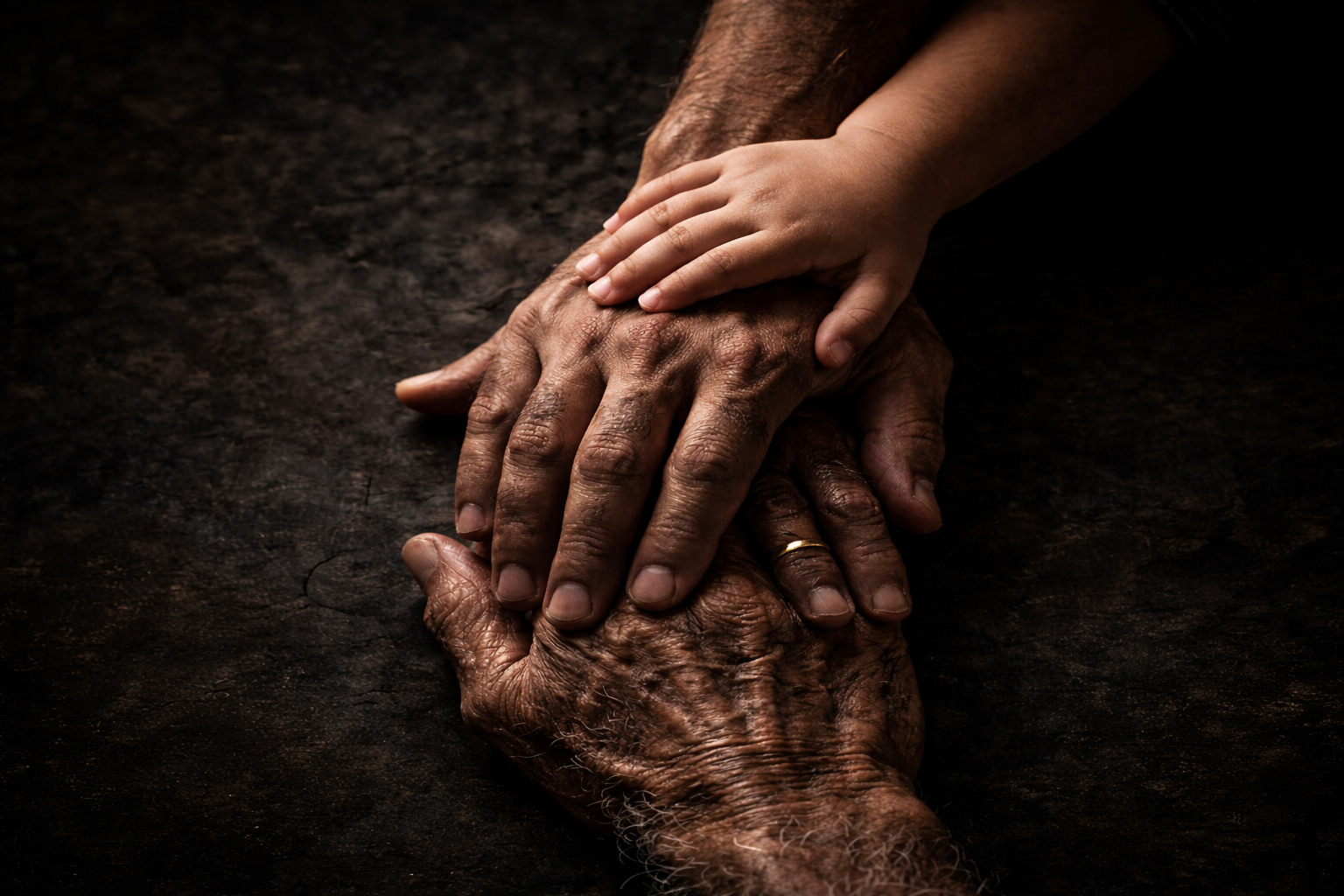
One afternoon, we were playing on the bed. He was jumping—from the mattress to my stomach and back—with the gleeful abandon that only children possess. I grabbed his hand mid-leap, the way you do, and asked him, grinning: “Whose hand is this?”
“It’s mine,” he said.
We kept going. I asked about his foot, his elbow, his ear. He answered each time, laughing, and I laughed too. It was a game. And then, without warning, he paused, looked at me with the mild seriousness that three-year-olds occasionally summon from nowhere, and said:
“You can touch my hand, but you cannot touch me.”
The game stopped. Not because the mood changed—he was already jumping again—but because something in my chest had gone very still.
I have been processing that sentence ever since. Ten words, spoken by a child who cannot yet spell his own name, that contain the entire metaphysical project of one of the greatest philosophers in human history.
Maharishi Badrayan would have smiled. Broadly.
Jaimini’s World: The Philosophy of the Hand
To understand the weight of what my son said, you have to look back at the ancient world Badrayan lived in, and the philosophy he was responding to.
Jaimini, Badrayan’s most illustrious student, built one of the most sophisticated philosophical systems the ancient world has ever produced. His school, Purva Mimamsa, begins with a deceptively simple premise: the Vedas are a manual for correct action. Life is a performance, and the goal is to perform it rightly.
In Jaimini’s framework, the universe operates on the principle of Dharma—righteous action—enforced through the mechanics of karma. Do good, and goodness flows back. Neglect your duties, and the cosmic ledger adjusts accordingly. Jaimini spent his life mapping this system with the rigor of a mathematician.
Think of it this way: Jaimini was deeply, brilliantly concerned with the hand. Whose hand is it? What should it do? How should it act? He gave ancient India a complete and workable guide to living a life of meaning through action.
And it worked. For most people, in most circumstances, Jaimini’s framework remains extraordinarily useful.
But Badrayan, the teacher, had been listening to his student with deep respect and an even deeper restlessness. He had heard the question my son would one day ask, and he understood that Jaimini’s philosophy, for all its brilliance, had never quite answered it.
You can touch the hand. But can you touch the one the hand belongs to?
The Turning Point: From Action to Being
Badrayan founded Uttara Mimamsa—what we call Vedanta today. The name is telling: Vedanta means “the end of the Vedas.” Not their termination, but their culmination. The point toward which everything else was building.
His argument with Jaimini was not a rejection; it was an elevation. Badrayan agreed that righteous action was valuable. He agreed that duty mattered. But he insisted, with the quiet authority of someone who has seen further than most, that action alone cannot deliver what the human soul most deeply seeks.
Action operates within the physical world. It is bound by cause and effect, by time, by the endless chain of doing and consequence. You can build the most beautiful sandcastle on the beach, following every rule. But the tide comes in regardless.
For Badrayan, the highest human aspiration—Moksha, absolute liberation—could not be achieved by doing more. Liberation required a different kind of movement altogether. Not action, but understanding. Not karma, but jnana: pure, direct knowledge of what is real.
Brahman: The Untouchable Beneath Everything
When you look at the world, what do you see? Diversity. Multiplicity. A hand here, a face there, a thought arising, a cloud passing. Everything is changing. Nothing holds still.
Drawing on the deep wells of the Upanishads, Badrayan asked: is there something beneath all this flux that does not change?
His answer was Brahman—the absolute, unchanging, undivided reality that underlies the entire universe. It is not a god in the conventional sense. It is the answer to the question: What remains when you have stripped away everything that comes and goes?
And here is the move that made Vedanta revolutionary. Badrayan taught that this universal, untouchable ground of being is identical to Atman, the individual self. The deepest “I” within you is not your thoughts, your memories, or your personality. Your deepest self is Brahman itself.
You can touch my hand, but you cannot touch me.
The child was right. The hand is real in the way all physical things are real—temporarily, touchably. But the me—the one who inhabits the hand, who notices the hand being touched, who says mine—that is something else entirely. That is the witness. The Atman.
This is what Jaimini’s framework could not quite reach. The hand can be disciplined and purified through action. But training the hand does not tell you who is wearing it.
The Brahma Sutras
To systematize this vision, Badrayan wrote the Brahma Sutras—terse, aphoristic threads of thought that attempt a completely coherent account of ultimate reality. Commentators across the centuries, from Adi Shankaracharya to Ramanujacharya to Madhvacharya, would spend entire lifetimes unpacking these seeds of argument. The text became the bedrock upon which a dozen schools of thought built their cathedrals.
He is the moment Indian philosophy grew up. The moment it stopped asking What should we do? and dared to ask Who are we, really?
The Line That Changed Everything
I keep coming back to that afternoon on the bed.
You can touch my hand, but you cannot touch me.
He was laughing when he said it. Already in motion, already reaching for the next jump. He has no idea that he articulated, in a single breath, the core distinction that separates ancient Indian philosophy’s two great branches. He doesn’t know about Jaimini or Badrayan, about karma or jnana.
He just knew—the way children sometimes know things before the world teaches them to forget—that the hand his father was holding was not the same as the person inside the hand.
I became a father in a hospital corridor three years ago. But I think I am still learning, one afternoon at a time, what that means. My son runs toward the world with open arms, and in his wake, trailing after him, I find pieces of the oldest wisdom quietly waiting to be picked up.
Maharishi Badrayan spent his life pointing toward the untouchable self—the one that no action can reach, no hand can hold, no tide can wash away.
The sages needed sutras.
He needed only Ten words.
My son calls it me.
And he is not wrong.
My father once showed me the outer path of responsibility. My son now points me toward the inner path of being. Between them, I am being asked to gather the courage to go within.
Just Think Over It.
Maharishis dedicated their lives to unravel the deepest secrets of existence. Spare some time while you still can to understand their work.
Maharishi Kapil(Samkhya Philosophy)
Connect with me on Reditt: r/JustThinkOverIt
Connect with me on X: @JustThinkOverIt