
Like every son who is forced to grow up without his father, I remember him with a peculiar tenderness. There are things I never understood when he was alive. The battles he fought quietly. The fatigue he swallowed. The arithmetic he must have done in his head to feed a family of seven.
I remember the routine more than the emotions.
He woke up early. Bathed. Dressed. Left for work six days a week without fail. He was a banker, posted in towns not far from our village. Most of the customers knew him personally. He returned home every evening around seven or eight. Dinner was served promptly. If the food pleased him, a rare smile appeared. A glass of milk concluded the day. Then sleep. Then repetition.
I do not remember him speaking about workplace politics. I do not remember him complaining about superiors. I am not even sure he knew the word “passion,” let alone believed one must chase it. He never discussed changing careers. Never fantasized about taking a break. He did what had to be done, and he did it without ceremony.
He fed his family. He bought land. He built houses. He educated his brothers and his children. He arranged marriages. He supported his mother after his own father passed earlier than expected. Role after role, executed without theatrical emotion.
Looking back, I see a man who performed every responsibility assigned to him with astonishing competence. The education he gave me is the reason I stand where I stand today. I feed my family because he fed his. My freedom is an extension of his discipline.
I lost him thirteen years ago.
I stood at his funeral pyre and watched his body burn. I remember the flames taking hold of his legs — the same legs I used to touch when leaving home, the same legs that walked to work every morning without protest. The image is etched in unnerving clarity. I stood there for hours.
The flames did their job.
They did not hesitate. They did not mourn. They did not question meaning. They obeyed the law of fire.
The emotions were mine, not theirs.
For the first time in my life, I felt an unexpected relief: I am not eternal. One day, I will lie on a similar pyre, and my son will stand where I stood.
When I think about it now, I see something larger than grief. I see continuity. I see a structure. I see rules operating beneath the drama of human feeling. I see a lineage moving forward like a current.
And I see the words of Maharishi Jaimini coming alive.
Indian philosophy has always attracted a particular kind of reader: the seeker. Someone in search of liberation, transcendence, a way out of suffering. The tradition obliges them generously. It offers Vedanta’s dissolving of the self into the infinite, Yoga’s quieting of the mind, Buddhism’s elegant escape from craving. The great systems bend, almost uniformly, toward exit. They treat the world as a problem to be solved by leaving it.
Maharishi Jaimini was not interested in any of that.
He has been largely forgotten as a result. And that forgetfulness is costly.
Jaimini authored the Mimamsa Sutras, the foundational text of the Purva Mimamsa school of Indian philosophy. If you seek mystical transcendence or lyrical reflections on the soul, he will disappoint you. He was not concerned with escaping the world. He was concerned with operating within it correctly — with precision, without sentiment, without drama.
For Jaimini, the universe is not a poem to be felt. It is a mechanism to be understood. It runs on precise, unyielding laws. Your task is not to transcend the system. Your task is to read its instructions and execute your role with accuracy.
To understand Jaimini is to encounter the ultimate pragmatist. He is the philosopher of action. The jurist of ritual. The defender of duty stripped of every comfort except this one: the structure holds, if you do your part.
The Eternal Word
Modern thought assumes that language is human invention — a convenient set of labels attached to objects. Jaimini inverted this assumption.
According to Purva Mimamsa, language is not invented. It is structural. The connection between a word (Shabda) and its meaning (Artha) is eternal and intrinsic. Words are not arbitrary; they are woven into reality itself.
This doctrine culminates in the principle of Apauruseya — the claim that the Vedas are unauthored. Not written by man. Not dictated by God. They are not compositions but discoveries. They are acoustic structures embedded in the universe, perceived by ancient seers.
Why insist on authorlessness?
Because authors err. Human beings are biased, emotional, limited. If the foundational instructions of reality were authored, they could be flawed. By removing the author, Jaimini removed fallibility. The text stands beyond personality.
You do not read it to feel uplifted. You read it to extract commands.
Language, for Jaimini, is not inspiration. It is instruction.
Dharma as Command
The word “Dharma” today floats in abstraction — righteousness, morality, spirituality. Jaimini refused vagueness. In his opening sutras, he defined Dharma with austere clarity: Dharma is that which is indicated by an injunction.
Dharma is command.
It is not an internal emotion. It is not intuition. It is not what feels right in the moment. Human feeling is unstable. Dharma is objective, external, prescribed action.
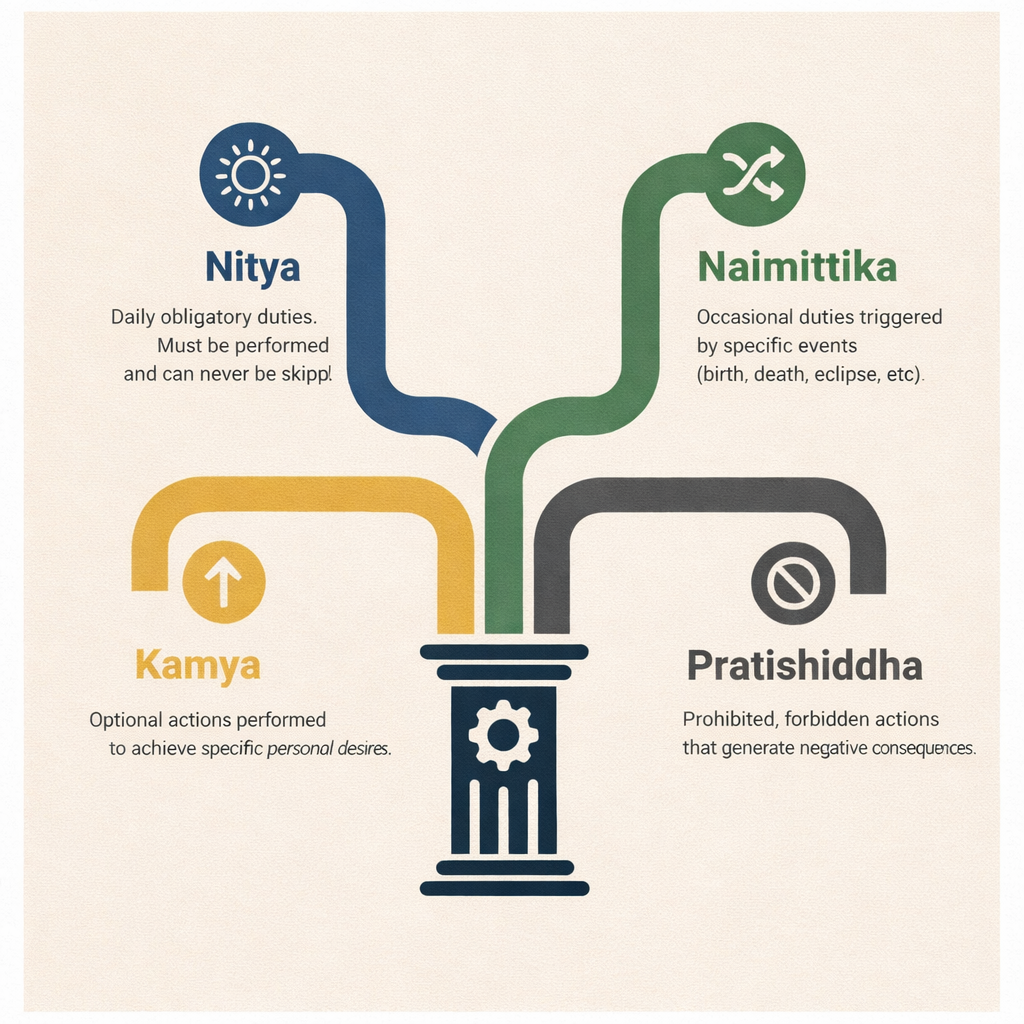
He categorized actions with surgical precision. Nitya Karmas are daily obligatory duties — no reward for performance, but severe consequence for neglect. Naimittika Karmas are duties triggered by specific events. Kamya Karmas are optional acts performed to obtain desired outcomes. And Pratishiddha Karmas are prohibited acts that disrupt order.
This framework is not poetic. It is mechanical.
A man goes to work daily. There is no applause. There is no trophy. But if he stops, the structure collapses.
The fire burns wood not because it loves or hates. It burns because that is the law of fire.
Jaimini applied this same principle to human life.
You perform your duty because it is required — not because you feel inspired.
Interpreting the Code
If reality is structured by eternal instruction, interpretation becomes critical. What if texts seem contradictory? What if commands clash?
Jaimini developed a rigorous hermeneutic system to resolve ambiguity.
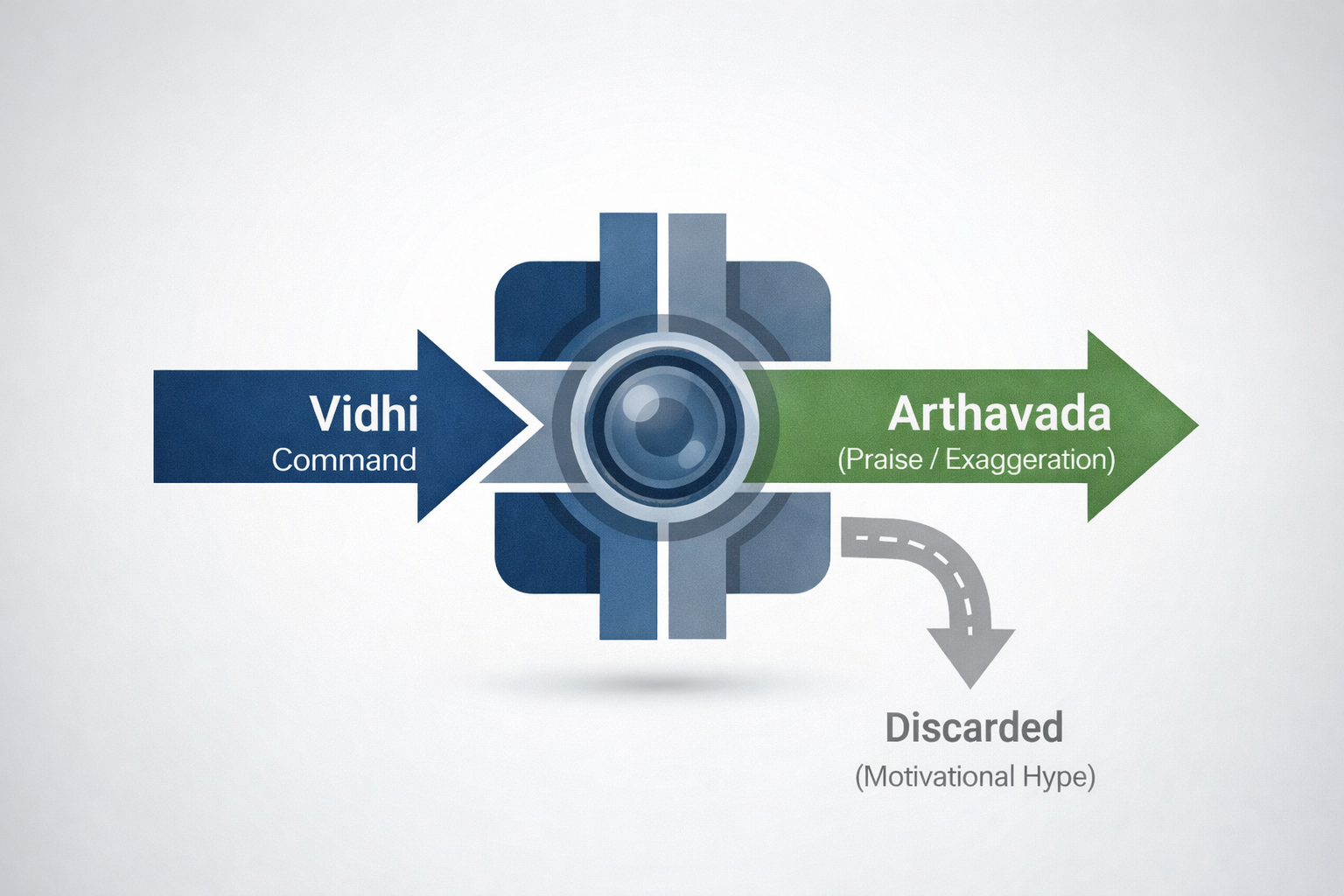
First distinction: Vidhi vs Arthavada. A Vidhi is a binding command. An Arthavada is explanatory or motivational embellishment. If a text praises a ritual as granting heavenly bliss, that praise is Arthavada — encouragement. The actionable core is the Vidhi: perform the ritual.
Second principle: Utsarga and Apavada. A general rule (Utsarga) may be qualified by a specific exception (Apavada). The exception does not invalidate the rule; it refines its scope.
This legal precision ensured that no contradiction shattered the system. The structure remained coherent.
Jaimini treated sacred text as executable code.
Apurva: The Invisible Continuity
Yet one question remains.
If actions are momentary, how do they yield results long after they conclude?
Jaimini introduced Apurva — an unseen potency generated by correct action. When a duty is executed, the physical act ends, but it leaves behind a latent force. This invisible momentum persists until conditions allow it to manifest as result.
No divine judge required.
Action produces consequence through structural continuity.
A father works tirelessly for decades. His labor ends each evening. Yet the unseen residue of those actions accumulates. Years later, it discharges as his child’s education, stability, and opportunity.
The energy is conserved.
The system remembers.
Jaimini had a name for the reasoning that makes this possible: Arthapatti — postulation. When two observable truths appear irreconcilable, you posit a third unseen fact that makes both true simultaneously. The act ended. The result came years later. Both are real. Therefore something persisted in between. You do not need to see it. You need only to accept that reality must remain coherent.
This is not mysticism. It is logic applied to time.
A Universe Without a Creator
Strikingly, early Purva Mimamsa exhibits little interest in a creator deity.
If the texts are eternal, they need no author.
If action generates result automatically, no cosmic judge is required.
The gods named in ritual are functional referents within linguistic structure — not necessarily anthropomorphic beings awaiting emotional devotion.
The power resides in correct execution.
The rule is sovereign.
This is not atheism in the modern sense. It is something stranger and more demanding: a universe that runs on law, not mercy. A cosmos indifferent to prayer but exquisitely responsive to correct action. There is no one to petition. There is only the work to be done, and the consequence that follows from doing it rightly.
For a man who grew up watching his father rise before dawn and return after dark, who never once saw him appeal to divine intervention but simply returned to the task each morning — this is not a cold philosophy. It is a precise description of what he witnessed.
The Dignity of Mechanical Duty
We live in an era intoxicated with passion. We are told to chase inspiration, align with emotion, optimize fulfillment.
Jaimini offers a counterpoint both cold and consoling.
You do not need to be perpetually inspired.
You do not need existential clarity each morning.
You need to identify your duties and perform them.
The man who rises six days a week, who eats his dinner, drinks his milk, and sleeps without complaint — he is not unimaginative. He is holding the structure together.
My father never philosophized about Dharma.
He embodied it.
He did not speak of cosmic systems. He operated within one.
At the funeral pyre, the flames did not grieve. They obeyed their law. He obeyed his.
The rules work.
The system holds.
You did your duty.
I will do mine.
See you soon, Papa
Maharishis dedicated their lives to unravel the deepest secrets of existence. Spare some time while you still can to understand their work.
Maharishi Kapil(Samkhya Philosophy)
Just Think Over It.

Very beautifully explained… I enjoyed reading every sentence.. Jaimini s philosophy has been very aptly interwoved with our daily life.. Very few people understand this..
Thank you dear author for this beautiful insight
Thank you for reading so attentively. Jaimini becomes alive only when we see him in ordinary life. I’m glad it resonated with you. More reflections coming soon.
Isn’t it confusing? There is no conclusion, if we are just doing the daily work without thinking of why we are doing are we really happy by doing it then what’s the difference between human and a robot? We are doing it for survival first. Then the word survival changes to savings for future survival then to standard of living and then to luxury.
Then what is the conclusion of this confusion?
That’s a powerful question. Jaimini would argue that mechanical action does not make us robots — it makes us participants in order. The difference lies not in constant emotional analysis, but in conscious alignment with duty. Survival may be the beginning, but dignity is the refinement. I’ll explore this tension further soon.