I. The Madness of the Twelfth Year
Fifteen years have passed, and still, the mere ghost of her eyes can make my heart skip a beat.
If there is any tangible heaven on this planet, I experienced it in those fleeting, silent moments of crossing paths. The dark kohl making a stark contrast against her skin, her ever-smiling face, and what I perceived to be her sudden, profound interest in my existence — it turned the axis of my world completely upside down. Sleep became a difficult, almost unwanted task. I fell asleep thinking of her, and in the quiet, empty hours of the early morning, I would wake to find her memory already holding my hand. During the day, I could only catch glimpses of her. But at night, with my eyes closed, I possessed her completely. If falling head over heels had a face, it looked back at me from my own mirror.
It was Class 12. There was a mad, desperate rush of studies echoing through the school corridors, driven by teachers who seemed far more interested in the syllabus than in the psychological survival of their students. Board examinations are framed as the ultimate landmark in an Indian student’s life. We are repeatedly fed the most ridiculous, pervasive lie of the modern education system: Study hard this year, and the rest of your life will be easy. This statement should be outlawed. Even flat earthers look wise next to the promise that solving calculus at seventeen will guarantee lifelong peace. As if the crushing weight of the Class 12 curriculum wasn’t enough, we were simultaneously prodded to prepare for hyper-competitive entrance exams.
And right in the middle of this endless, suffocating madness of words, physics formulas, and parental expectations, millions of years of evolutionary biology were quietly hijacking the wheel.
One part of your brain desperately wants to focus on thermodynamics, while the older, deeper part completely surrenders to the geometry of a classmate’s smile. I experienced this mutiny firsthand. We had been in the same school for a year and a half, entirely unaware of one another’s existence. But then, an invisible switch flipped. I have no logical explanation for how I noticed her sudden interest in me, but the mind sees what it is desperate to see. I even convinced myself I could read the words I love you hidden inside her passing glances.
II. The Swing
My sanctuary during this academic storm was the chairman’s lawn. A friend and I had practically moved into that patch of grass about eight months before the board exams. There were two large swings facing each other, which we repurposed as makeshift beds and study desks. Our towering stacks of books were kept in the shade nearby. Everyone in the school knew that lawn belonged to us.
Then, on one ordinary evening, I walked out of my room and headed to the lawn.
There she was. Sitting on the swing I usually used as a bed, quietly reading a book. When I entered, she looked up, saw me, smiled, and asked simply if I wanted her to leave.
I had never truly noticed her before. Not like this. But in that lawn, in that specific light, those mundane words coming from her smiling mouth struck my chest with a force I had no language for. I froze. I just stood there, staring. After an agonising few seconds, the social conditioning of my brain reminded me that a response was required.
The honest answer, screaming from every cell in my body, was: Please, never leave. But years of building a false, protective teenage personality filtered it out. Instead, I muttered, “You can read as long as you want. Just don’t make noise.”
I lied when I said earlier that I had no clue when I noticed her interest. It was that exact evening. This is what she does to me — I still cannot think straight. The sun went down that day, but it ignited a fire inside me that made rational thought impossible.
III. The Architecture of a Phantom
From that day forward, wherever I went, my eyes actively hunted for her — and because the mind is a brilliant editor, I nearly always found her. Simply having her in my vicinity increased my energy to such a volatile level that aiming for petty board examinations felt utterly absurd. Which sane person would care about mathematical proofs when the deepest, most primal instincts of human nature are screaming at you to pay attention to the girl on the swing?
Days evaporated. The eight months to the exams bled into four. In my own mind, I was the most passionate, tragic, and victorious lover in the world — the luckiest man alive, because the prettiest girl in the school had chosen me.
In reality, not a single word had been exchanged since that evening on the swing.
To prove to myself the depth of this grand romance, I did something terrifyingly irrational. When the time came to fill out our final examination forms, I changed one of my subjects. I dropped a subject I had been studying for a year and a half and switched to the one her best friend was taking. I risked my academic future entirely on the delusion that her best friend would act as a bridge, somehow leading me to her.
My preparations, which had been going at full speed months prior, collapsed into a distant second priority. Occasionally, in the dead of the night, a quiet, rational voice would whisper that I was making an absolute fool of myself. I would use my hormone-addled brain to violently kick that voice back into the dark.
The mounting pressure of the impending boards, disastrous marks in the pre-boards, and ridiculous results in the mock tests eventually forced me to pull my books closer. But it was simply too late. The infection had spread to the paper itself. I remember staring at an oval shape in my mathematics textbook, and slowly, inexplicably, the geometry morphed into her face. I was incapable of putting her away.
Months passed. Still, no words were exchanged. In the airtight theatre of my mind, she was simply playing hard to get, and I was the devoted, patient protagonist waiting for the final act.
IV. The Light Turns On
The exams finally arrived. I, a student who had historically been a high scorer, walked into the examination halls feeling like a failure before I even picked up a pen. The worst moment came when that exact mathematics question featuring the oval geometry appeared on the paper. Needless to say, I lost my grip on reality right there at the desk. I prayed for passing marks. I could see the trajectory of my life turning upside down, and I possessed absolutely no power to stop it. My heart — or perhaps my lust — was in total, dictatorial control of my existence.
When I finally returned home after the last exam, without ever sharing a fraction of my internal agony with her, without even securing a phone number, reality delivered its blow.
Through a mutual acquaintance, I was casually informed that she was the girlfriend of a boy in the commerce section. They were happily planning their future together.
Two months later, the board results were announced. My mark sheet bore the permanent, numerical scars of my imaginary romance. I had sacrificed my focus, my peace, and a year of my life for a ghost.
It was, in the words of ancient India’s greatest intellectual, a masterpiece of Maya.
V. A Different Species of Suffering
Siddhartha Gautama, the Buddha, was a clinical physician of the mind. He diagnosed the pain of impermanence — Anicca — the quiet dread we feel because we know that every real experience is eventually going to end. It is the ache of the holiday running out, the last evening before someone leaves.
But the pain I felt holding that mark sheet was a completely different species of suffering. I was not mourning the end of a real relationship. I was reeling from the devastating realisation that the relationship had never existed in the first place.
If the Buddha explained why we suffer when the movie ends, Adi Shankaracharya explained why we are fools for crying at the movie at all.
Operating in the 8th century, Shankara was the defining architect of Advaita Vedanta — Non-Dualism. He was not a mystic whispering in a cave. He was the ancient equivalent of a theoretical physicist trying to locate the absolute base fabric of reality, and he was ferociously systematic about it.
Where the Buddha argued that the universe is a flowing river of temporary processes and that the “Self” does not exist — Anatta — Shankara arrived at the exact, diametrically opposite conclusion.
Shankara argued that the flowing river is the illusion. The “Self” experiencing it is the only thing that is actually real.
VI. The Rope and the Snake
To understand how my teenage brain completely fabricated a romantic epic out of a single polite sentence, we must understand Shankara’s most famous analogy.
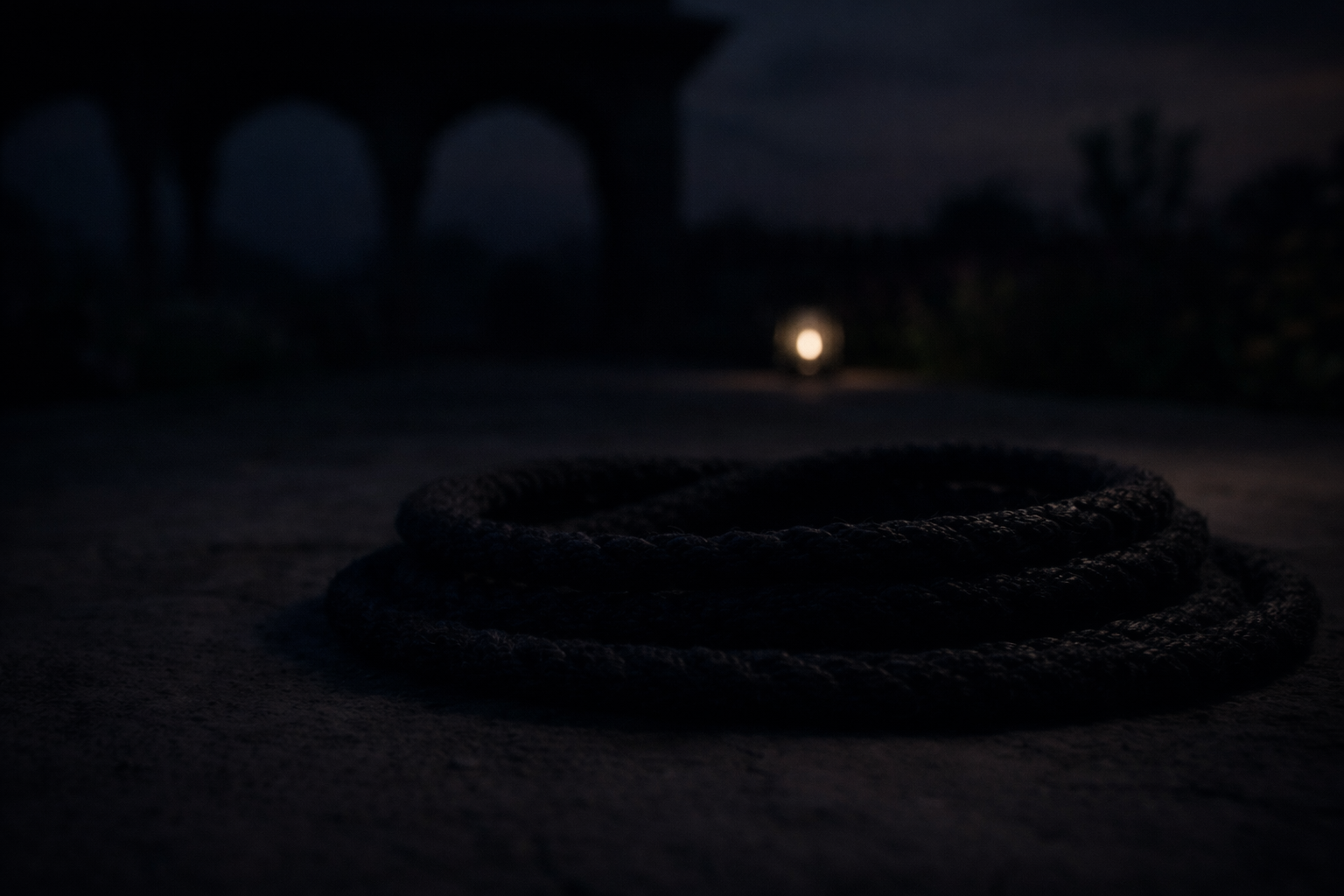
Imagine a man walking down a dirt path at dusk. In the dim light, he sees a coiled shape on the ground. He instantly recognises it as a venomous snake. His heart rate spikes, his palms sweat, and he feels genuine, visceral terror. He is paralysed by fear.
Then, a friend walks up with a lantern and shines a light on the path. The man looks down and realises it is not a snake at all. It is just a coiled piece of rope left behind by a farmer.
Instantly, the terror vanishes.
Let us examine the mechanics of this fear. Was the man’s terror real? Yes — the adrenaline in his blood was a biological fact. But was the object of his terror real? No. The snake only existed inside his own mind.
Shankara used this to explain the fundamental problem of human existence. The rope is objective, neutral reality — Brahman. The snake is the illusion — Maya. We suffer because we treat the temporary projections of our own minds as absolute reality.
On that evening in the chairman’s lawn, the girl on the swing was the rope. She was just a person, reading a book, being polite. She was entirely neutral. The grand, cinematic romance, the secret glances, the destiny I constructed around her — that was the snake. My joy, my sleepless nights, and my eventual devastation were one hundred percent real. But they were a reaction to a phantom.
VII. The Twin Engines of Delusion: Avarana and Vikshepa
How does a rational mind — one capable of solving complex physics equations — fall for the snake? How did I convince myself that changing my examination subjects would magically align my stars with a girl who had not spoken to me in months?
Shankara explained that Maya — and individual ignorance, known as Avidya — operates through a terrifying, two-step cognitive mechanism.
The first power is Avarana — the Power of Concealment. Before your mind can lie to you, it must first hide the truth. In the dusk, the darkness conceals the true nature of the rope. In my school, my hormones and my ego threw a thick veil over the objective reality of the situation. Avarana hid the glaringly obvious facts — that we did not speak, that she did not look at me the way I looked at her, that she had an entire life running in parallel to my fantasy of her.
Once the canvas of reality is wiped blank by concealment, the second power takes over: Vikshepa — the Power of Projection. This is the mind’s terrifying ability to project a completely fictional reality onto the blank space. Once my mind hid the truth, it projected a sweeping, dramatic love story onto her polite smile.
This leads to the ultimate cognitive error, which Shankara called Adhyasa — Superimposition.
Adhyasa is when you take the attributes of one thing and falsely paste them onto another. The most literal, startling example of this in my life was staring at the mathematics textbook. I was looking at ink printed on paper in the shape of an oval. But through the power of Adhyasa, my mind superimposed the attributes of her face onto the geometry. I was no longer seeing mathematics. I was seeing my own delusion, reflected back at me from the page.
VIII. The Screen and the Movie
It is easy to look back at a teenage crush and laugh at the absurdity of it. But Shankara’s philosophy is infinitely more dangerous than just explaining adolescent heartbreak.
He argues that your entire life is the snake.
We do not just superimpose romantic stories onto classmates. We superimpose the identity of “Manager” onto ourselves and suffer panic attacks when the company misses a target. We superimpose the idea of “Success” onto a specific bank balance and feel like failures when the market corrects. We superimpose the concept of “Mine” onto houses, cars, and even our children — setting ourselves up for the inevitable devastation when the universe reclaims them, as it always does.
If everything we experience — our careers, our heartbreaks, our societal standing — is just a projection, a movie played by Maya, then what is actually real?
If you strip away the snake, you find the rope. If you strip away the movie, what is left?
The screen.
Shankara called this Brahman. Brahman is not a man with a beard sitting on a cloud managing the affairs of the universe. Brahman is pure, unadulterated, infinite consciousness. It is the blank, silent cinema screen upon which the chaotic, heartbreaking, beautiful movie of the universe is projected. The screen does not judge the movie. The screen does not burn when a fire is projected onto it, and it does not get wet when an ocean is shown. It simply is.
IX. The Ultimate Plot Twist: Tat Tvam Asi
The orthodox religions of the world generally teach that you are a tiny, flawed creation, separated by a vast gulf from a massive, perfect Creator.
Advaita Vedanta shatters this duality entirely. Shankara’s ultimate conclusion is summarised in the Upanishadic phrase Tat Tvam Asi — Thou Art That.
You are not the desperate boy crying over the girl. You are not the engineer stressing over the blueprints. You are not the body that is ageing, and you are not the mind that is constantly fluctuating between joy and dread. Those are all just temporary costumes — characters in the movie.
You are the screen.
Your individual consciousness — Atman — and the universal consciousness — Brahman — are not two different things. They are exactly the same thing. You are like a single wave in the ocean, terrified of crashing upon the shore, forgetting that you are not a separate entity called a “wave.” You are the ocean, temporarily folding into a shape.
X. Waking Up
When I finally realised that the girl on the swing was dating someone in the commerce section, the pain was sharp — but the cure was instantaneous. I did not need therapy. I did not need to travel to the Himalayas or perform a ritual.
All I needed was information.
The moment the light of truth was shone on the situation, the illusion evaporated. You cannot be afraid of the snake once you know it is a rope.
Because the fundamental problem of human existence is not a physical disease, Shankara argued that the cure cannot be a physical action. You cannot meditate your way to Brahman. You cannot earn your way to liberation. The problem is ignorance — mistaking the movie for reality. Therefore, the only cure is Jnana — Knowledge.
Liberation, Moksha, is not a golden city in the clouds you go to after you die. It is waking up from the dream while you are still lying in the bed.
The boy on the swing, the girl reading the book, the mathematics exam, the broken heart — all of it, just light projected onto a wall.
The movie is going to play regardless. The tragedies will happen, the comedies will unfold, and the characters will fall in and out of love. But when you finally realise you are the screen, the movie loses its power to hurt you. You can sit back in the dark, watch the light flicker, and finally enjoy the show.
Just think over it.
Spare some time — while you still can — to understand their work.
Further Explorations of the Maharishis
Maharishi Badarayana_Bramhasutras (2)
Maharishi Gautam (Nyay Philosophy)
Maharishi Kapil (Samkhya Philosophy)
Connect with me on Reddit: r/JustThinkOverIt
Connect with me on X: @JustThinkOverIt