I. October
October was a month I always looked forward to. Festivals brought holidays, and holidays at a boarding school were an event unto themselves. The festive season arrived with a loosened schedule, food that broke from the institutional routine, and most importantly, a flowering of cultural activities. The annual sports day fell on the eleventh of December, and its preparation began in October — which made that entire stretch feel charged with something the calendar alone couldn’t explain.
Classes thinned. Some students were pulled into practice. The daily routine, which ran the school like clockwork through the rest of the year, began to breathe. And with it, something lifted across the campus.
The weather helped. The heat of summer had started waning, and a moderate cold breeze had begun to soothe the skin. Every living soul on campus had a spring in their walk. It is remarkable, if you think about it, that a single month can distribute happiness so evenly across so many people — year after year, like a kept promise. And at the centre of it all was an anticipation that made the days feel both full and fast.
Isn’t that curious? That the anticipation of something often gives higher pleasure than the thing itself?
I was good at yoga, so I was part of the sporting extravaganza every year. I practiced with my friends and other participants, and there was a real delight in showcasing what I had cultivated. Complex poses came naturally to me, and the appreciation from teachers and fellow students acted like a booster shot — I worked harder, refined more, wanted to be better. There is a well-known alchemy in this: preparation, appreciation, celebration, and above all, anticipation — a cocktail that sped time up so efficiently that December 11 arrived the way all awaited things do. Suddenly.
II. The Gate
After sports day, school closed for a month and everyone was required to return home. In those final days, I was usually among the last to leave. I used to carry the bags of my friends to the school gate when their parents came to pick them up. Nobody told me to. But by simply being with them — walking that five-hundred-metre stretch from the parents’ meeting area to the gate — I felt the joy of going out through that gate over and over again. The hugs as my friends crossed over, the promises to meet again, the occasional tears — it felt like the purest connection one could possibly feel. Clean, unambiguous, real.
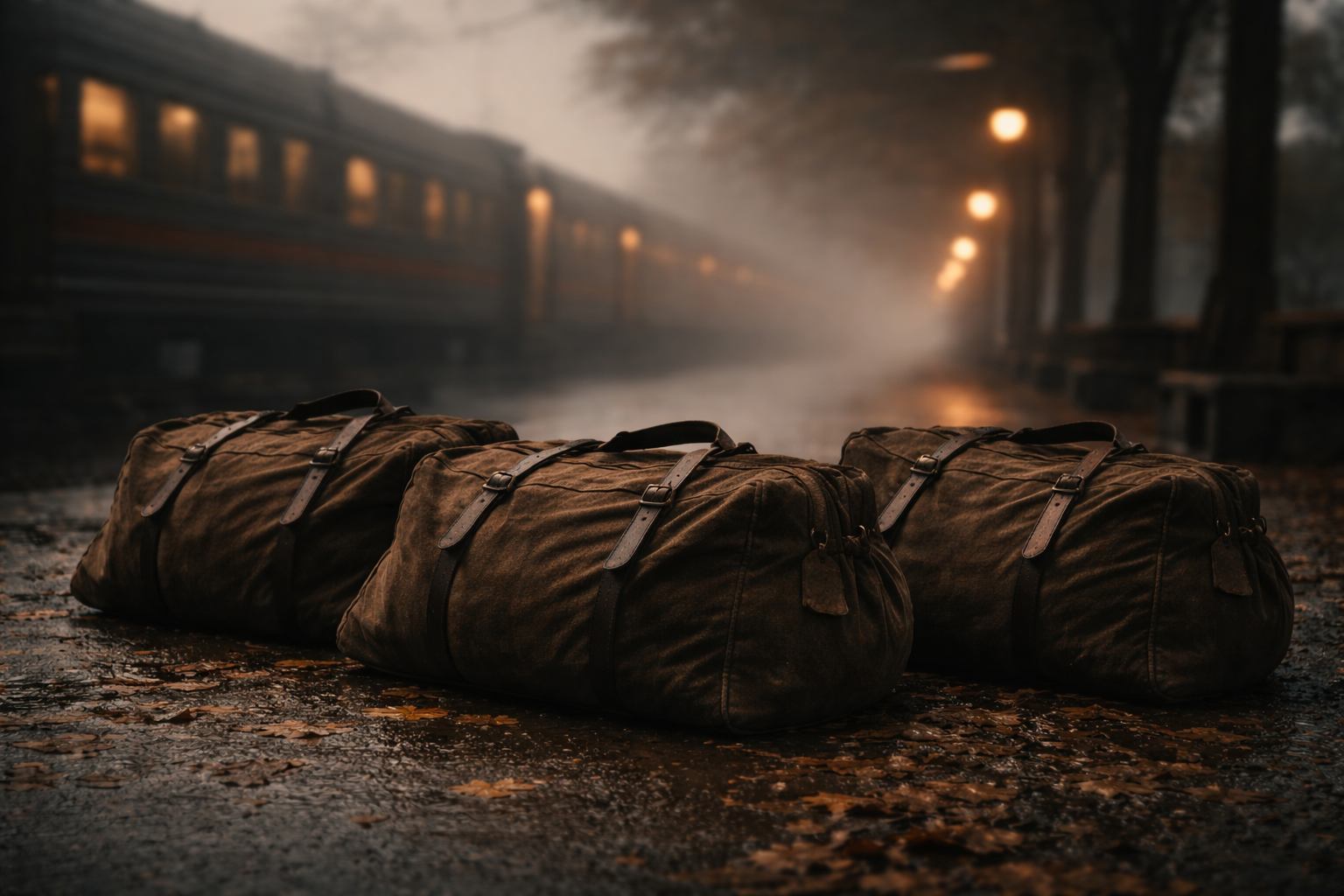
When my guardian came for me, I had two or three big bags packed with things I had anticipated using at home. Mostly books. Bags full of books are heavy bags. It did not matter. What followed was a seventeen-hour train journey, and with my luggage neatly stacked under the seat, I felt something uncomplicated: freedom.
Even a slow-moving train felt good.
My father usually came to receive me at the station. The smell of the surroundings, the sound of local dialects in the air, the familiar smell of food from the railway platform — and then, his hand on my back. An embrace. That familiar path from the station to home, which was only some distance away, felt divine. My mother would be waiting, having cooked the dishes she knew I loved. My sisters talked to me like I meant something. By any measure, a happy home.
III. The Dread
A few days into the holiday, something began.
It was faint at first—easy to dismiss—but it grew steadily, like a tide you only notice once it has arrived. The dread of return. The closer the date of departure crept, the louder this note became, until it was no longer background but foreground, coloring everything. Each good day felt like a step closer to the end. The better I felt at home, the stronger the dread of leaving became.
The happiness did not disappear, but it was no longer clean. It came with an asterisk.
Haven’t you wondered why good times always pass so quickly? Two months of anticipation for one month of holiday had felt purer and more sustained than the month itself. I wanted to freeze time and never let go. Alas, it was not my call.
Years passed. The desire to freeze good moments stayed intact, while the capacity to do so did not improve. And the frustration of it slowly crystallised into something sharper: if every good time arrives bundled with the hidden dread of its ending, then there is no such thing as a fully good time. The joy and the anxiety are not separate events.One lives inside the other.
Ironically, this dread vanishes the moment something undesirable begins. Time slows. The mind stops thinking about loss—and starts thinking about survival.
Over two millennia ago, a prince named Siddhartha Gautama sat in a palace designed to be the ultimate happy home, felt this exact same dread, and arrived at an unusual solution.
IV. The Physician
It would be a fatal mistake to approach this man as a deity or a mystic. He was, in the language of our time, an extraordinarily rigorous phenomenologist — a thinker who refused to speculate about the universe until he had first diagnosed the immediate emergency of the human mind.
He possessed everything the modern professional exhausts himself trying to acquire. A kingdom’s wealth, a perfect family, palaces engineered to shield him from the sight of sickness, aging, and death. And yet he felt the exact same creeping dread. He recognised that the palace was, at bottom, a very comfortable waiting room for loss.
The Maharishis of the orthodox Indian schools spent lifetimes debating grand metaphysical architectures — the nature of the soul, the fabric of the universe, the mechanics of karma. Siddhartha, essentially, told them to stop. He illustrated his impatience with what became known as the Parable of the Poisoned Arrow. If a man is shot with a poisoned arrow, he does not pause the physician to ask what wood the shaft is made of, what caste the archer belongs to, or what feathers dress the fletching. If he demands those answers before allowing treatment, the poison will kill him.
For the Buddha, humanity is that man. The arrow is psychological suffering. The only relevant question is how to remove it.
V. The Physics of Impermanence
His diagnosis begins with Anicca — Impermanence — which is less a philosophical position than a description of how reality is actually structured.
We look at the world and see nouns. A home. A father. A school. The Buddha argued that the universe is composed entirely of verbs. A river is not a noun; it is a continuous process of flowing. A fire is not a glowing object; it is an unbroken event of combustion. Everything — without exception — is in a state of constant arising and passing away.

He extended this further, into what he called Pratityasamutpada, Dependent Origination: nothing exists independently. A tree is not a freestanding object but a temporary event — the fleeting collision of soil, sunlight, water, and time. Alter the conditions and the tree ceases to be.
When I sat in my bedroom wanting to freeze time, I was making a demand the universe is constitutionally incapable of honouring. I was asking reality made of flowing verbs to solidify into a noun. Stasis is an ontological impossibility. Suffering, in this framework, is not a punishment. It is what happens when we insist on a rule the universe simply does not possess.
VI. The Architect of the Dread
With impermanence established, the Buddha mapped the human condition through the Four Noble Truths with the precision of a physician completing a diagnosis.
This creeping dread is what he called Dukkha. Often translated weakly as suffering, Dukkha is better understood through its root image — a wheel slightly off its axle. Not dramatic agony. The fundamental background hum of existential unsatisfactoriness. The subtle friction present even on your best days. The whisper: this will end.
What generates this friction? He called it Tanha — craving, thirst, the desperate demand to freeze what is moving. The pain I felt as a boy was not caused by the fact that I had to return to school. It was caused by my craving for the holiday to last forever. We grasp at youth, at relationships, at the warmth of a childhood home, screaming at a fluid universe to hold still. The tighter we grip water, the faster it escapes, and the more our hands ache. The dread is simply the friction between a universe that insists on changing and a mind that refuses to accept it.
VII. The Illusion of the Passenger
But the Buddha was not finished. His most dangerous and brilliant move was still to come.
If the universe is a flux of dependent conditions and nothing is permanent, what about the person experiencing all of this? What about the I that was doing yoga, seeking appreciation, riding the train, standing inside a father’s embrace?
The orthodox schools believed in an eternal, unchanging soul — the Atman. The materialist Charvakas believed we were biological machines and nothing more. The Buddha took neither position. He proposed Anatta: No-Self.
The Self, he argued, is a grammatical illusion.
What we call I is a temporary, rapidly shifting grouping of five processes—physical form, sensation, perception, mental formations, and consciousness. It is a flipbook moving fast enough to create the illusion of a solid, continuous picture. Stop the pages and there is no picture. There are only pages.

This matters because if there is no permanent Self, who is doing the craving? We spend our lives frantically constructing, defending, and promoting an identity — building an ego — to convince ourselves we exist permanently. The boy seeking appreciation for his yoga poses is building an ego. The boy terrified of leaving his father’s embrace is protecting one. The Buddha’s radical surgery reveals this: the suffering arises because we are desperately trying to protect something that was never quite there in the way we imagined it to be.
VIII. The Blowing Out
The goal of this deconstruction is not nihilism, and this must be stated plainly.
The goal is Nirvana — a word whose literal translation is the blowing out, as in extinguishing a candle. What is extinguished is not feeling, not love, not engagement with the world. What is extinguished is the algorithm of craving. When a mind truly sees that there is no independent Self to protect, and no way to freeze a fluid universe, the craving mechanism quiets. The ontological friction drops to zero.
If I had possessed this understanding as a boy, it would not have meant loving my parents less, or enjoying the train journey with less gratitude. It would have meant the exact opposite. By releasing the impossible demand to freeze the moment, you are finally able to inhabit it. You can actually taste your mother’s food. You can actually feel your father’s hand on your back — completely unpoisoned by the anxiety of the impending goodbye.
The desire to freeze time is the very thing that prevents us from experiencing it.
I carried my friends’ bags to the gate not because anyone asked me to, but because I wanted to participate in the joy of their going. I walked that five-hundred-metre stretch over and over, feeling the warmth of each departure. Without knowing it, I had stumbled onto something — there was more fullness in helping them leave than there would ever have been in clinging to their staying. Release, it turns out, is not the opposite of connection. It is its purest form.
True freedom is not the train ride home.
It is the walk to the gate—
carrying the bags,
and smiling as the goodbye happens.
For the first fifteen days, I avoided the books I had carried home. “I’ve just arrived,” I told myself. “Let me enjoy.” In the next fifteen, I avoided them again. “I’m leaving soon,” I thought. “I’ll have to read them anyway.”
We don’t live the moment—even when we have it.
Just think over it.
The Maharishis dedicated their lives to unraveling the deepest secrets of existence.
Spare some time — while you still can — to understand their work.
Further Explorations of the Maharishis
Maharishi Badarayana_Bramhasutras (2)
Maharishi Gautam (Nyay Philosophy)
Maharishi Kapil (Samkhya Philosophy)
Connect with me on Reddit: r/JustThinkOverIt
Connect with me on X: @JustThinkOverIt