I. The Upper Berth
Separation is a distinct, heavy species of pain.
When I was in boarding school, the final week of a holiday felt like a ticking time bomb. Every new sunrise brought me closer to an exit I desperately wanted to stop but couldn’t. My journey back to school involved a seventeen-hour train ride. The scheduled departure was in the evening, but the train rarely arrived before midnight.
I was young, and someone had to escort me to the station at that odd hour. Because my father could not drive, I was always at the mercy of relatives. One winter night, that duty fell to my uncle.
He was not a bad man, but he was a severe one. He was notorious for asking children sharp questions and mocking them if they made a mistake. The error itself was enough to make a child feel inadequate, but the mockery rubbed salt deep into the wound. He was not very popular among the kids, though highly respected by their mothers for his ability to “tame the devils.”
He and another relative took me to the station around 23:00 hours. The two gentlemen were chatty, but I remained entirely silent. I felt numb. The agony of leaving my home, and the people inside it, was burning a hole in my chest. If I had been alone, I would have wept loudly just to release the pressure. But flanked by these two stoic men, I was terrified that if I shed a single tear, I would be mocked for the rest of my life. I kept crying inside, with no tears visible.
Then, through the cold night air, I heard my uncle speaking to the other relative.
He said that when you walk through the night, you never feel the distance you have covered. Same with a father’s money — you never feel how much you have spent. He was saying both were true of me.
I had asked my father to send me to this boarding school, and it was expensive. My father had somehow managed it, but his brother felt the weight of that expense more acutely than the man who was actually bearing it. He could not resist dropping those words as my parting gift.
Thankfully, the train arrived and my agony in their company ended. I was alone on my upper berth. The loud clattering of the tracks and the dark isolation of the berth finally made room for the tears to come out. I cried. I cried like there was no tomorrow. I had many hours of the journey left, and I travelled with those words echoing inside me. They created a wound that still bears scars.
II. The Malware
I never told my father, but I always felt guilty for the financial stress I was putting on him. To compensate, I tried my best to save as much as I could. I borrowed books from seniors and teachers. Any paid activity in school was simply a no-go for me. I preferred staying hungry over paying for extra food in the canteen. I never drank milk because it cost extra. For years, I owned no clothes apart from my school uniform.
I studied as long as my body allowed, trying to extract the maximum possible value out of the money we were giving to the school. I did everything my little brain could conceptualise to ensure my already stressed father felt somewhat less pressure.
Despite my best attempts, the expenses were high. I felt terrible about it anyway. And then those words arrived. My uncle was entirely absent from my daily life, yet somehow a man I barely saw was running it — dictating my diet, shrinking my wardrobe, generating a persistent, low-frequency guilt that became the background noise of my adolescence.
III. The Demigods and the Prophecy
All that extra effort made me a very good student. I was consistently among the highest-ranked in the class, and good marks brought the affection of teachers. I was rarely forced to attend the extra, mundane activities required of hostel kids — warden speeches, additional roll calls, the theatre of institutional compliance.
In my school, there was an interesting ritual for students passing into the 9th and 11th grades. The previous year’s class topper would be called in for a formal meeting with the vice principals and teachers. We were encouraged to ask them questions. On campus, toppers were celebrities. I looked up to them as if they were demigods. I admired them so much that I never actually had any questions. I simply felt speechless in those meetings.
It never really occurred to me that I could be one of those students.
Until one afternoon. My biology teacher called me into his chamber and delivered a single, unadorned sentence: “I want you to be the topper of the class next year, and I am going to make it happen.”
I felt so happy, it was as if I already were the topper. He never spoke about it again until my last day with him. But his words stayed with me throughout. Something inside me permanently changed.
The work was always there, but when a vision was attached to it, it became something that simply could not be described. My sense of time disappeared. People would have to drag me to my bed. I ate as fast as I could; the taste of the food became irrelevant. I dressed at 7:00 in the morning and stayed in the exact same uniform until 1:00 or 2:00 AM. There were no sports uniforms or evening kurta pyjamas for me, despite the school rules. Eventually, the teachers and the warden stopped saying anything. Physically, I was in the school. Mentally, I was in a completely different dimension.
All that mattered were those five subjects and my effort to understand every word written in them. To many people, I had become a maniac. To me, I was almost meditative.
The effort began to show. The pre-board exams brought nearly 100% marks across all subjects. I faced nearly twenty different internal exams before the finals, and the scores kept repeating themselves. Everyone thought I could very well become the highest scorer in the history of my school.
All it took was a few words from my teacher to turn me into a completely different being. The exact same can be said about the words of my uncle.
Flesh and bone decay. But words have a life of their own.
IV. The Architect of Reality
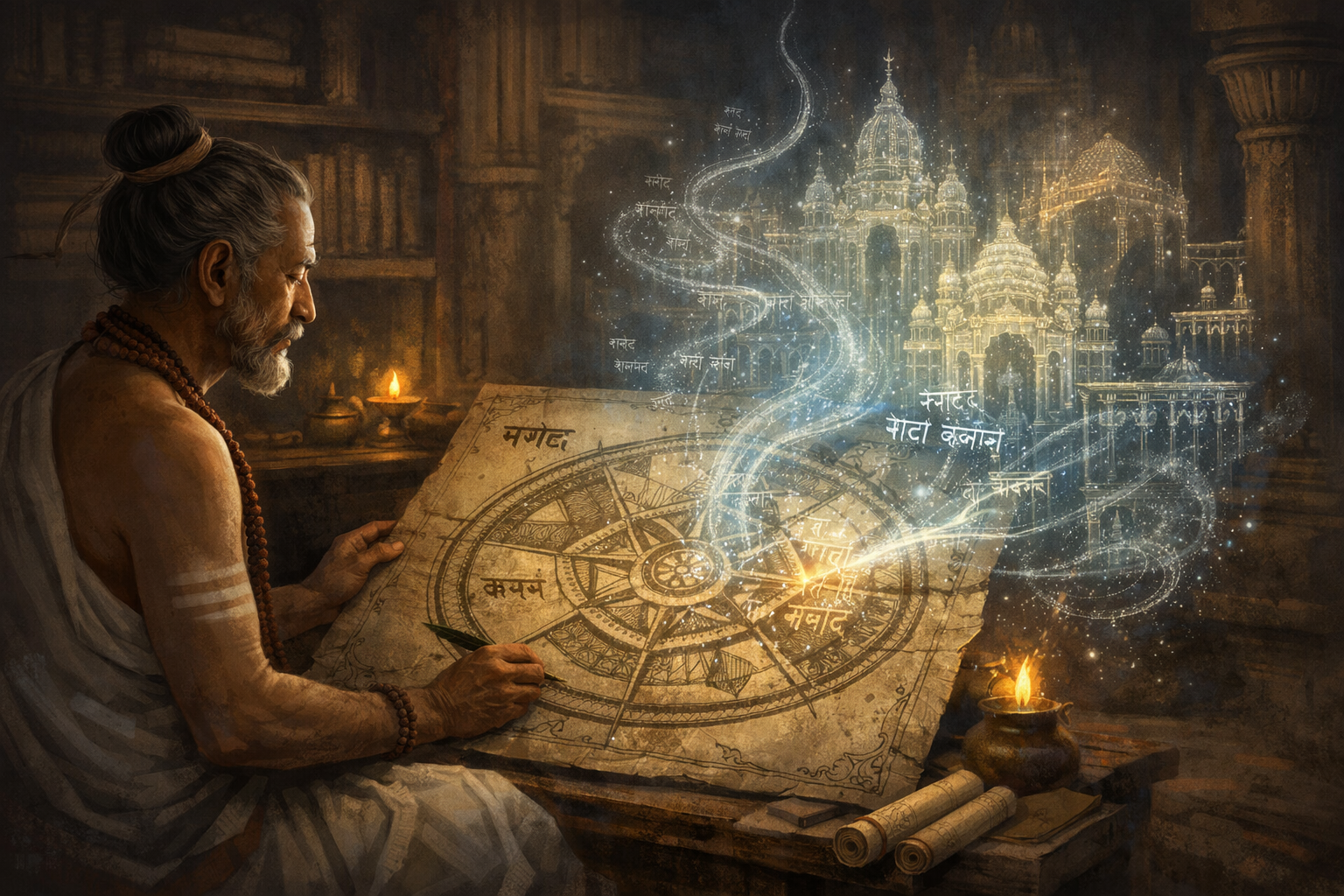
In the 5th century, a philosopher named Bhartrihari looked at exactly this phenomenon and wrote a masterpiece called the Vakyapadiya.
While the Buddha deconstructed the mind and Shankara exposed the illusion of the universe, Bhartrihari asked a different, more architectural question: what is the actual tool the mind uses to construct our reality?
His answer was radical. He argued that the ultimate, base fabric of reality is not atoms, and it is not even silent consciousness. The base fabric of reality is Language. He called this concept Shabda Brahman — the Word-Absolute.
We generally believe that a physical world exists and that we invented words simply to label its objects. Bhartrihari argued the exact opposite. You cannot have a thought without a linguistic structure to hold it. Language does not merely describe reality. Language generates it.
Think of the human mind as a computer. Words are not the text displayed on the monitor. Words are the underlying binary code — the 1s and 0s — that actively programs the software and determines what the machine can and cannot do.
When my uncle spoke those words into the cold night air, he was not simply vibrating air through his vocal cords. He was writing a line of code into my operating system. A man I barely saw was running a programme I could not see — restricting my calories, shrinking my wardrobe, generating a physical reality shaped entirely by a sentence spoken in the dark. The code continued executing long after the moment that produced it had passed, quietly governing a life it had no right to govern.
V. The Burst of Meaning
If language is the code of reality, how does it actually alter the mind? Bhartrihari explained this through his most important theory: Sphota.
Sphota translates roughly as “bursting” or “flashing.” When someone speaks a sentence, the sounds arrive sequentially, one word after another. But your understanding of that sentence does not happen sequentially. The moment the final word lands, a complete, indivisible unit of meaning bursts into existence in your consciousness — all at once, like a photograph developing in full.
Consider what happened when my uncle spoke. The sounds hit me one by one in the cold night, but the meaning detonated as a single, unified explosion. A verdict. A life sentence delivered without a trial. The Sphota of his words did not produce a thought. It produced a self-image — a boy who consumed without consciousness, who walked through the dark not counting his steps. And that self-image quietly built the physical world I then inhabited: the hunger, the borrowed books, the same uniform worn until 2 AM.
The same mechanism ran in reverse when my biology teacher spoke. Before his sentence, the concept of me being a topper simply did not exist in my universe. I viewed those students as demigods; I was just a boy trying not to waste money. But the moment he spoke, a Sphota exploded in my mind. It did not feel like receiving information. It felt like becoming someone.
That new self-image changed my physical actions — the abandoned dress code, the vanished appetite, the nights stretched into early morning. And those physical actions changed the physical reality of the school’s record books.
The word literally built the future.
VI. The Architecture You Inherit
Here is the part that most of us miss. We walk around believing our inner life is private, self-authored, original. We think our fears, our appetites, our sense of what we deserve — these are conclusions we arrived at through our own experience. Bhartrihari would say otherwise. Most of what we call our inner life is inherited architecture. It was built by sentences we did not choose to receive, spoken by people who often had no idea what they were constructing.
My uncle was not trying to alter the trajectory of my adolescence. He was making conversation with another adult while waiting for a midnight train. He had no idea he was writing code. That is precisely what makes it so dangerous. The architects of our inner world are rarely aware they are building anything.
The corollary is equally important. When my biology teacher called me into his chamber, he was not delivering a motivational speech. He said one sentence, once, and never repeated it. He simply placed a word inside a young mind and trusted it to do what words do — take root, expand, and eventually rewrite the walls of the world around it.
This is the terrifying implication of Shabda Brahman. Every sentence you speak to a child, a student, a grieving friend, a person standing at the edge of a decision — you are not making conversation. You are making their world. The grammar you hand them becomes the grammar they think in. The grammar they think in becomes the life they live inside.
And the sentences you speak to yourself in the dark — when no one is listening, when the train is clattering through the night and the berth is yours alone — those are the most powerful of all. Because no external architect is more relentless than the one you have internalised and handed the keys to.
Bhartrihari wrote his philosophy fifteen centuries ago. But the code he described is still running in every one of us, executing instructions laid down by people who may no longer even be alive, governing lives they never imagined.
The question is not whether you are living inside a language someone else wrote for you.
The question is whether you have noticed.
Just think over it.
Maharishi Badarayana_Bramhasutras (2)
Maharishi Gautam (Nyay Philosophy)
Maharishi Kapil (Samkhya Philosophy)
Connect with me on Reddit: r/JustThinkOverIt
Connect with me on X: @JustThinkOverIt