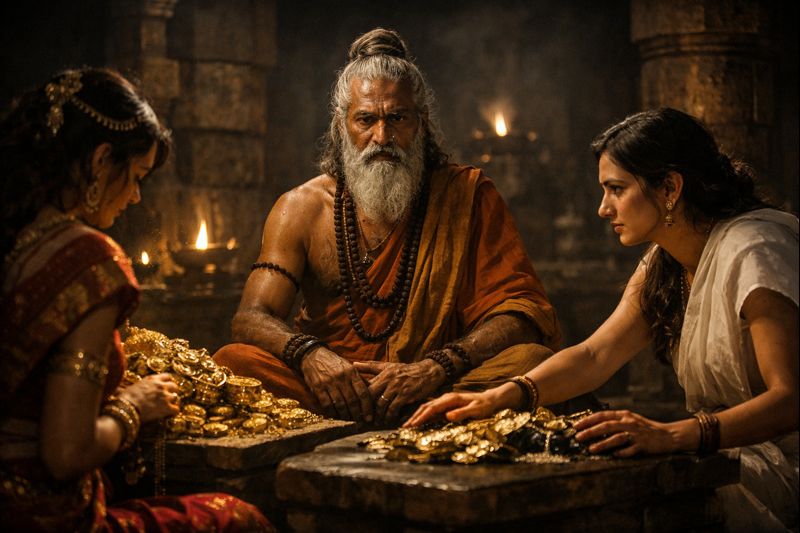
From a teenage heartbreak to the forest of Renunciation—how the greatest dialogue in Indian philosophy solves the problem of human loneliness.
The Rusting Rod
When I was in school, there was a girl.
I won’t write her name here, but I can assure you—she was life itself. As far as I can remember, she was always smiling. She carried a kind of light that made everything around her seem a little less dull.
Whenever her eyes met mine, it felt like lightning hitting my heart. It was a physical jolt. She would smile and say hello, and I—terrified, awkward, and overwhelmed—would freeze. Inside, I wanted her to stay forever. I wanted to tell her everything. But outside, for the sake of “Image Maintenance,” I acted like I felt nothing. I played it cool. I played the “strong, silent type.”
Decades later, I still feel like a loser when I visit that memory.
While I was busy keeping my “cool image” intact, a guy I considered a total loser—someone who was good at nothing except swing bowling—asked her out.
She accepted.
I watched from the sidelines as they became inseparable. They were together during lunch breaks, after school, during evening study sessions, and even the night study sessions (thankfully, the hostels were separate).
They were peas in a pod. And I was a rusting rod.

No amount of reflection could make me understand it. I looked at myself, carefully curating my persona, my grades, my future. I looked at him—messy, loud, just a bowler. And I asked the question that destroys the ego of every young man:
Why would a girl of that quality pick a guy of that quality?
School ended. We all went ahead in our respective lives. That girl went on to become a top Doctor in India. I never heard the guy’s name again. But the question didn’t leave me. It stayed lodged in my subconscious like a splinter.
I saw the pattern repeating everywhere. I saw brilliant people chasing “average” partners. I saw wealthy people chasing “simple” lives. I saw the inexplicable nature of attraction and connection, and I felt like I was missing a piece of the puzzle.
Time, place, and situation changed, but the pattern continued.
And then, years later, I met Maitreyi.
She wasn’t a girl from my school. She was the wife of the Great Sage Yajnavalkya, living thousands of years ago in the Kingdom of Videha. She asked her husband a single question, and his answer finally explained why I was the rusting rod, and why the swing bowler won the girl.
But before we get to the answer, we have to set the scene.
The Fork in the Road: Katyayani vs. Maitreyi
In Part 1, we left Maharishi Yajnavalkya at the absolute peak of his game.
He had walked into King Janaka’s court, challenged the greatest minds of the era, and walked out with 1,000 cows, each with gold coins tied to their horns. He was the wealthiest intellectual in India. He had the fame, the tenure, and the assets.
By the standards of modern society, he had “won.” He was the Jeff Bezos of Vedic philosophy.
But the story doesn’t end with the money. It ends with him walking away from it.
One day, Yajnavalkya looked around his estate. He looked at the gold. He looked at the comfort. And he felt the same hollowness I felt when I bought my big-screen TV. He realized that “winning” the game hadn’t solved the problem of death or dissatisfaction.
He decided to enter Sannyasa (renunciation).
He called his two wives, Maitreyi and Katyayani, to the main hall of his estate to settle his affairs.
He said, “My dears, I am about to wander forth from this place. I am entering the next stage of life. Let me divide my property between you two so you are secure for the rest of your days.”
This moment is the archetypal “Fork in the Road” for every human being. The two wives are not just historical figures; they represent the two halves of the human brain.
Katyayani represents the Material Mind. She heard “property division” and likely felt relief. She was essentially saying, “Okay, great. Make sure I get the house, the cows, and the liquid assets.” She is the part of us that wants the EMIs paid, the fridge stocked, and the 401(k) maxed out. She values Security.
Maitreyi, however, represents the Spiritual Intellect. She didn’t look at the settlement papers. She looked at her husband’s face. She saw that he was leaving all this wealth to go find something else. And her logic was razor-sharp: If the gold is so valuable, why is he leaving it? And if he is going to find something better, why is he giving me the scraps?
She asked the question that haunts every rich person eventually:
“Sir, if this whole earth filled with wealth were mine, would I become immortal by it?”
Yajnavalkya looked at her. He could have lied. He could have said, “Yes, darling, money will make you happy forever.” But he gave her the most honest financial advice in history:
“No. Like the life of rich people will be your life. You will eat good food and wear soft clothes. But there is no hope of immortality through wealth.”
Maitreyi pushed the settlement papers away.
“Then what should I do with that by which I do not become immortal? Tell me what you know. Give me the wealth you are taking with you.”
Because she rejected the assets, Yajnavalkya sat her down. He saw that she was ready. She didn’t want the “Mirror” (the money); she wanted the Light.
And so, he revealed the Great Secret of Human Relationships.
The Hard Pill: “You Do Not Love Me”
Yajnavalkya starts the lesson by dropping a bomb. He looks at his loving wife and tells her that her love is an illusion.
“Verily, not for the sake of the husband is the husband dear, but for the sake of the Self is the husband dear.”
“Not for the sake of the wife is the wife dear, but for the sake of the Self is the wife dear.”
“Not for the sake of the sons are the sons dear, but for the sake of the Self are the sons dear.”
When you first read this, it sounds like extreme, cold-hearted selfishness. It sounds like the manifesto of a narcissist.
Is he saying, “I only love you because you make ME feel good?” Is he saying, “I don’t love my son; I just love the feeling of being a father?”
If I love my son only because he boosts my ego, that’s not love. That’s a transaction.
But Yajnavalkya is going much deeper than psychology. He is talking about metaphysics.
He is saying that every human being is programmed to seek Joy (Ananda). We spend our whole lives hunting for this Joy.
We think the Joy is inside the iPhone. So we buy it.
We think the Joy is inside the Girlfriend. So we chase her.
We think the Joy is inside the Promotion. So we work for it.
But Yajnavalkya argues: The object is dead matter. The iPhone is plastic and glass. The money is paper. They do not contain Joy.
The Joy is inside YOU.
The “Self” (Atman) is the source of all happiness. When you get what you want (like the iPhone or the lover), your mind briefly stops desiring. When the mind stops running, the calm surface reflects the light of your own Self.
You feel happy. But you make the mistake of thinking the object gave you the happiness.
In reality, the object just acted as a Mirror. When you kiss your spouse, you aren’t tasting them; you are tasting the Love that is already in your heart, reflected back to you by their presence.

The Permission Slip Metaphor
To understand this, let’s go back to my story about the big-screen TV.
I spent years dreaming of that TV. I stood outside the shop like a beggar. When I finally bought it, I felt a rush of euphoria. I felt “healed.”
But where did that euphoria come from? Did the TV beam a “happiness ray” into my brain? No. The TV just sat there.
The happiness came from me. The TV was just a Permission Slip I gave myself to finally be happy. I told myself, “Okay, now you have the big screen, now you are allowed to feel good.”
Yajnavalkya is teaching us that we spend our lives begging the world for Permission Slips.
We beg our boss for a promotion so we can feel worthy.
We beg our partner for attention so we can feel lovable.
We beg the stock market for returns so we can feel safe.
We are billionaires of Joy acting like beggars, asking the world to give us a few pennies of satisfaction.
Yajnavalkya is telling Maitreyi: “Stop loving the Permission Slip. Love the Source. Don’t love me as a body, because my body will die and leave you broken. Love the Self in me. Because the Self in me is the exact same Self that is in you.”
The Algorithm of Freedom: Neti, Neti
Maitreyi, being the sharp intellect, likely asked: “Okay, I understand. The joy is in the Self. But how do I find this Self? I have spent my whole life looking outward.”
This is where Yajnavalkya introduces the most famous algorithm in Indian philosophy: Neti, Neti (Not this, Not this).
It is a process of ruthless subtraction. If you want to find the Truth, you don’t add things (like more degrees, more money, or more beliefs). You remove things.
Look at your hand. Are you the hand? No, you can observe the hand. If you lose the hand, you still exist. So, Neti (Not this).
Look at your emotions. Are you the anxiety you feel right now? No, because the anxiety comes and goes, but “You” are still there watching it. So, Neti.
Look at your “Image”. Are you the “Cool Guy” at school? No, that is just a mask you wear to protect yourself. Neti.
If you keep peeling away the layers of the onion—the body, the mind, the ego, the career—what is left? Nothing?
No. The Observer is left. The Conscious Light that was watching the hand, watching the anxiety, and watching the ego.
Yajnavalkya tells Maitreyi:
“The Self is the Seer which cannot be seen. The Hearer which cannot be heard. The Thinker which cannot be thought.”
You cannot “see” your own eyes, because your eyes are the ones doing the looking. You cannot “know” the Self as an object, because the Self is the Subject.
This “Self” is what we are actually looking for. When we fall in love, we are actually falling in love with this spark of Life in the other person.
Closing the Loop: Why the Bowler Won
And this brings me back to the school corridor. To the girl with the smile, the swing bowler, and the “Rusting Rod.”
For twenty years, I wondered why she picked him. I thought it was a mistake. I thought I was the “high-quality” option because I had the grades, the manners, and the carefully maintained image.
But after reading Yajnavalkya, the answer hit me like a train.
I wasn’t offering her Me. I was offering her my Image. I was trapped in the “Neti” layers. I was identified with my persona, my coolness, my fear of rejection. I was a mannequin—perfectly styled, but hollow.
The swing bowler? He was a “loser” by society’s standards, but he was Real. He wasn’t maintaining an image. He was spontaneous. He was alive. When he laughed, he meant it. When he bowled, he put his heart into it.
He was closer to his Self.
The girl wasn’t looking for a “resume.” She was looking for Life. She felt the spark of the Atman in him—the uninhibited, joyous energy of the Self. When she looked at me, she saw a wall. When she looked at him, she saw a window.
Yajnavalkya was right. “Not for the sake of the husband is the husband dear, but for the sake of the Self.” She loved the Self in him because he allowed it to shine. I had buried mine under layers of fear and pretense.
I was a rusting rod because I was rigid. They were peas in a pod because they were both alive.
Conclusion: Walking Into the Forest
The dialogue ends in a way that is strikingly modern and abrupt.
Yajnavalkya finished his teaching. He didn’t wait for applause. He didn’t ask Maitreyi to sign a waiver. He didn’t set up a consulting firm to teach this wisdom for a fee.
The texts simply say: “Having spoken thus, Yajnavalkya departed.”
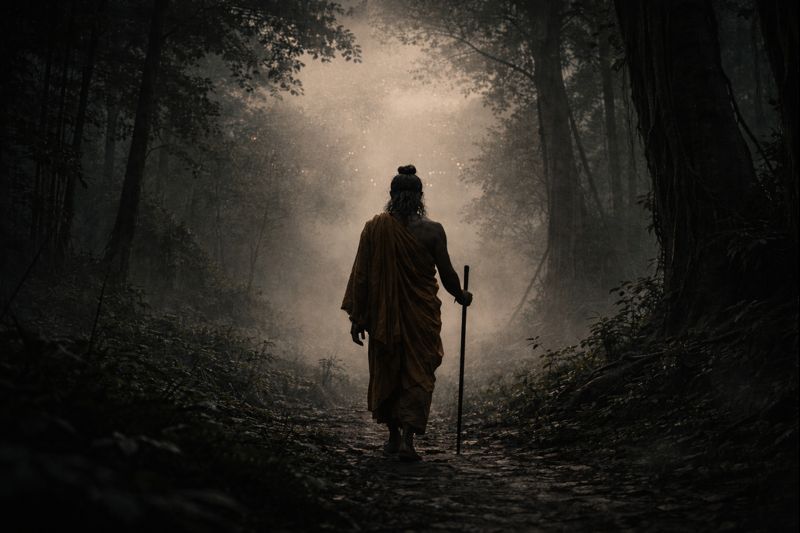
He stood up, left the palace, left the 1,000 cows, left the gold, and walked into the forest.
He didn’t leave because he hated the world. He left because he no longer needed the world to tell him who he was. He had found the Source. He didn’t need the “Permission Slips” anymore.
Maitreyi didn’t follow him. She didn’t need to. She stayed in the palace, amidst the gold and the luxury. But she was no longer a “Rich Wife.” She was now a Knower of Brahman. She understood that the gold on her wrist and the God in her heart were made of the same light. She could enjoy the wealth without being enslaved by it.
This is the lesson for us.
We don’t have to run to the forest. We have to pay our EMIs, do our jobs, and raise our families. But we can stop being “Rusting Rods.”
We can stop polishing our “Images” and start connecting with our “Self.” We can stop begging the world for happiness and realize that we are the ones supplying it.
If you can do that, you can be like Maitreyi—sitting in the middle of a golden palace, totally free.
P.S. That mask is still tied to my face. I am still maintaining that “fake person,” only now I do it in my workplace instead of at school. Philosophy is merely a tool. If you don’t use it, it has no power.
Just Think Over It.
Maharishis dedicated their lives to unravel the deepest secrets of existence. Spare some time while you still can to understand their work.
Maharishi Kapil(Samkhya Philosophy)

Pingback: The Ghost in the Grammar: Bhartrihari & The Architecture of Reality