Maharishi Kapil entered my life not through a book, but through a missed opportunity on the overcrowded shores of Gangasagar in eastern India—before I knew it was an opportunity at all.
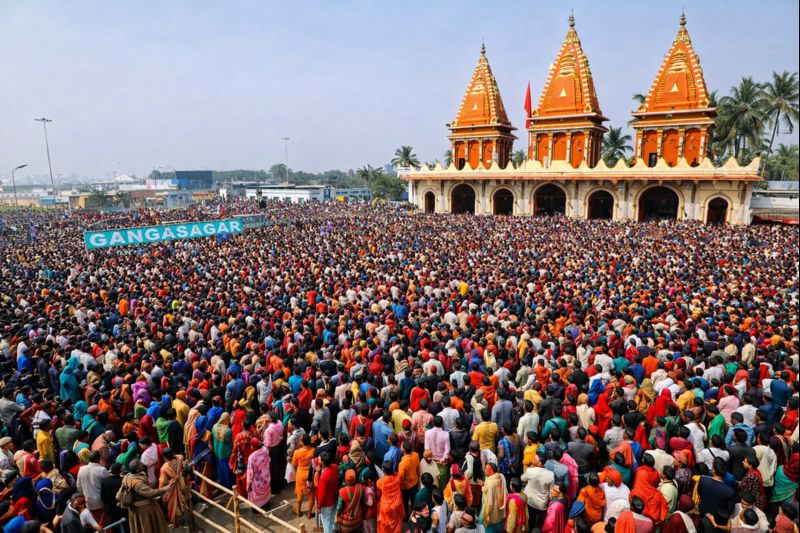
The “heaving sea of heads” at the Kapil Muni Temple in Gangasagar. It was this overwhelming crowd that caused us to skip the visit, leading to the pivotal moment with the conch seller.
I was about 15 years old. We had taken a bus from Kolkata, followed by a boat ride, to reach the sacred point where the River Ganga merges with the Bay of Bengal. It was Makar Sankranti, and the place was a heaving sea of heads.
However very near the beach stood a temple dedicated to Maharishi Kapil. The queue to enter was so long that my family and I decided to skip it entirely. We even joked about the people in our group—like my mother—who insisted on standing in that crushing crowd for hours.
“Do you even know who this Maharishi is?” I asked her, with the arrogance of a teenager. “Is he really worth this trouble?”
She had no clue. She had heard his name in TV serials but, like most people, knew nothing of his contribution to Indian thought. Consequently , I, the ‘modern’ youth, mistook ignorance for independence and felt no guilt in ignoring his temple.
The Price of Ignorance
Then, reality struck.Amid our jokes, we lost track of our surroundings. Unfortunately someone took advantage of our ignorance and snatched our bag. It contained clothes, personal items, and most importantly, all the cash for our trip. Suddenly, we were a group of ten, stranded near the sea of water amongst a sea of people, penniless and panicked.
Our lack of awareness—what the sages call Avidya—had already begun charging interest.
A nearby conch seller approached us. In our frustration, we snapped at him, shouting that we had been robbed and had no money for his shells. A normal person would have abused us back or walked away. Instead, he stood there, unmoved by our anger. He calmly asked us to accompany him to the police station. Then, he did something unthinkable: he offered us cash and his address, saying we could return the money once we reached home.
We refused the money, but I was stunned. Even though he was calm while we were chaotic—helpful, yet untouched by our panic.
Years later, when I finally opened the Samkhya Sutra, I realized the irony. That simple conch seller was living the philosophy of the Sage I had ignored. He was the “Witness” to the drama, not a victim of it.
I realized then that Maharishi Kapil is not just a name for a temple queue. He is the father of the framework that explains our suffering.
The Original Theory of Everything
Long before the microscopes of modern science began dissecting the atom, and centuries before Western philosophers debated the nature of existence, a sage sat in the forests of ancient India and mentally deconstructed the entire universe.
Kapil did not ask “Who is God?” Instead, he asked a sharper, more scientific question:
“What is the mechanism of suffering, and how do we dismantle it?”
His answer was a rigorous system that separates the ‘Seer’ from the ‘Scenery’—and ends suffering at that fault line.
The Great Divide: Purusha and Prakriti
At the heart of Kapil’s philosophy is a radical dualism. He argued that reality is two distinct, eternal principles inextricably mixed in our experience.
Imagine a cinema. You have the Screen/Projector mechanism, and you have the Audience. In Kapil’s view, the universe is a play of these two forces.
1. Purusha (The Silent Witness)
Purusha is the Soul, the Self, or Pure Consciousness. It is the “Audience” in the cinema, however, it does not act nor does it think—because thinking itself is mechanical. It does not change. Simply put ,it is the light of awareness that illuminates everything else.
Key Characteristic: Passive, Conscious, Eternal.
Its Role: To witness. Without Purusha, the universe would be a play performing in an empty theater—it would technically exist, but it wouldn’t be experienced.
2. Prakriti (The Great Matrix)
Prakriti is Nature, Matter, and Energy. It is the “Movie.” It is everything that is not you. This is the hardest pill for advanced readers to swallow: Your mind, your intelligence, your ego, and your emotions are all part of Prakriti, not Purusha. According to Samkhya, your thoughts are just subtle matter, swirling around like dust.
Its Role: To create experiences (Bhoga) and eventually lead to liberation (Apavarga) for the Purusha.
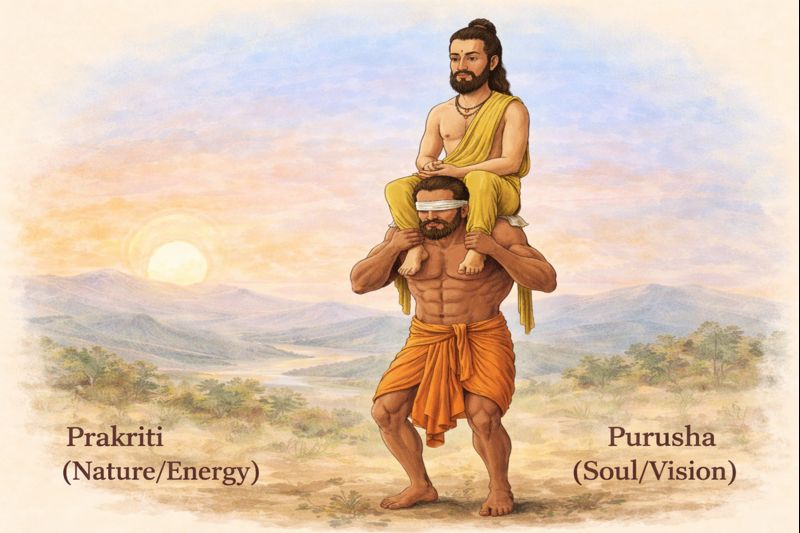
The Classic Analogy: Samkhya describes the relationship between these two as a Lame Man (Purusha)riding on the shoulders of a Blind Man (Prakriti). The Lame Man has eyes (consciousness) but cannot move. The Blind Man has legs (energy) but cannot see. Together, they navigate existence.
The classic Samkhya analogy: The Lame Man (Consciousness/Purusha) has vision but cannot move. The Blind Man (Nature/Prakriti) has strength but cannot see. Together, they create the journey of life.
Part I: The Code of Reality — The Three Gunas
If Prakriti (Nature) is the movie, what is the film reel made of? Maharishi Kapil identified three fundamental “strands” that weave together to form everything in existence. These are the Three Gunas.
For the advanced reader, it is crucial to understand that Gunas are not just “moods.” They are the fundamental frequencies of energy. In fact , matter is nothing but the Gunas in a state of imbalance. What follows is not moral judgment, but diagnosis.
The Guna Matrix: Decoding Your State
Dimension
Sattva (Harmony)
Rajas (Motion)
Tamas (Inertia)
Core Frequency
Light, Clarity, Balance
Fire, Friction, Passion
Darkness, Heaviness, Resistance
Physics Analogy
Potential Energy (Equilibrium)
Kinetic Energy (Velocity)
Mass / Entropy (Gravity)
Mental State
Calm, objective. You see things as they are.
Anxious, ambitious. You see things as you want them to be.
Confused, deluded. You fail to see things at all.
Experience of Time
Present Moment Awareness
Rushing toward the Future
Regretting the Past
The Trap
Attachment to happiness (“I am wise”).
Attachment to results (“I must win”).
Attachment to negligence (“I don’t care”).
The Eternal Dance Every moment of your life is a math equation of these three.
Depression: High Tamas, Low Rajas, Low Sattva.
Manic Panic: High Rajas, Low Tamas, Low Sattva.
Wisdom: High Sattva, Controlled Rajas, Low Tamas.
Part II: The Samkhya Theory of Evolution (Creation from the Top Down)
When we hear “Evolution,” we think of Darwin (Bottom-Up).However Maharishi Kapil proposes Involution or Cosmic Evolution (Top-Down). He describes how the subtle consciousness creates dense matter.
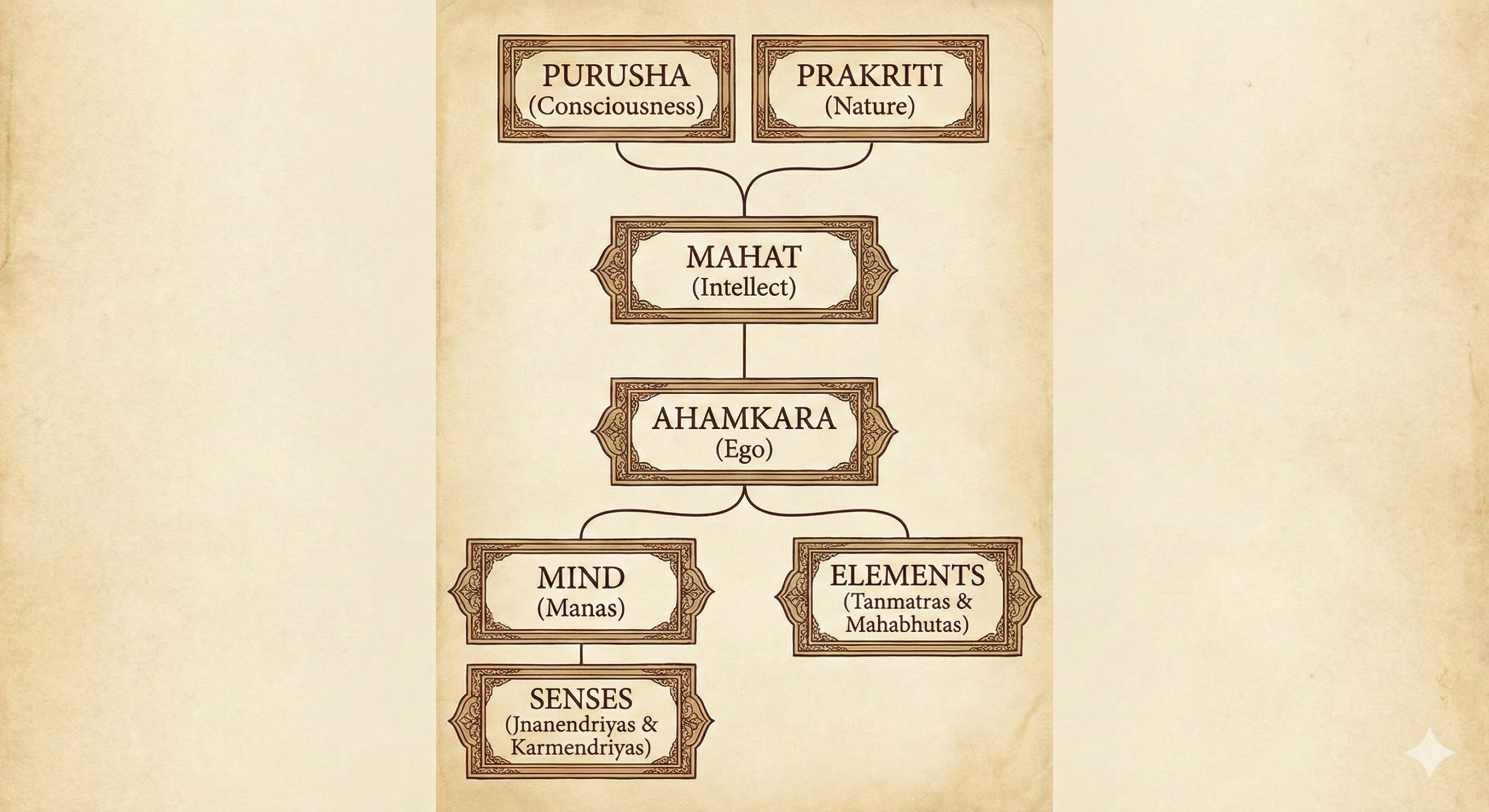
Kapil lists 24 Tattvas—not to be memorized, but rather to be recognized. This is the roadmap of how “I” came to be.
The Map of Creation: A visual guide to how the subtle “I-sense” evolves into the physical world according to Maharishi Kapil.
Stage 1: The Inner Instruments (Antahkarana) When the equilibrium of Nature is disturbed, the first thing to emerge is the template of the mind.
Mahat (The Cosmic Intelligence): The pure “I-sense.” In the individual, this is the Buddhi (Intellect).
Ahamkara (The Ego): The principle of individuation. It creates the boundary between “Me” and “Not Me.”
Stage 2: The Cognitive Suite (From Sattvic Ego)
3. Manas (The Mind): The central processor.
4. The 5 Jnanendriyas: The senses (Ears, Skin, Eyes, Tongue, Nose).
5. The 5 Karmendriyas: The organs of action (Speech, Grasping, Walking, etc.).
Stage 3: The Descent into Matter (From Tamasic Ego) From the heavy aspect of the Ego, the physical world condenses.
The Insight: “Earth” contains the qualities of all preceding elements. “Space” has only one (sound). This explains why Earth is the “heaviest” or most Tamasic element.
Part III: Kaivalya – The Exit Strategy
Why does Kapil map this out with such agonizing detail? Because you cannot escape a prison if you do not know the layout.
The goal of Samkhya is Kaivalya (Aloneness). This does not mean being lonely. It means the “Aloneness of the Purusha”—separating the Self from the noise of Prakriti.
The Process of Neti-Neti (Not this, Not this) By understanding the 24 Tattvas, you can start a process of elimination:
I am not the Body (Earth/Water/Fire…). That is just biology.
I am not the Mind. It is just a flickering screen of Gunas.
I am not the Ego. That is just a construct.
Then who remains? The one watching even the Ego—the Witness.
Summary for the Modern Seeker
Maharishi Kapil challenges us to stop identifying with the software. We spend our lives trying to fix the movie—trying to make the sad scenes happy, trying to edit the script.
Kapil says: Stop editing. Start watching.
When you understand that your anxiety is just an excess of Rajas vibration, you stop saying “I am anxious” and start saying “There is anxiety in the system.” Similarly, when you understand that your brain fog is just Tamas, you don’t judge yourself as “stupid,” you simply recognize the need for rest or movement.
That day in Gangasagar, I was lost in the movie—panicked, angry, and confused. The conch seller was the Audience—present, helpful, and inwardly untouched. He had found the “Aloneness” amidst the crowd.
This is the ultimate freedom. It is the realization that while the game of life is complex, the Player has always been free.
Samkhya does not ask you to escape the world—it asks you to stop mistaking yourself for it.
Just think over It.
Maharishis dedicated their lives to unravel the deepest secrets of existence. Spare some time while you still can to understand their work.